

Markets 101: Be the Market Maker, Not the Market Taker
How juice actually eats your edge on prediction markets — and why resting a bid a penny or two under the ask beats hitting the ask. Tonight’s card is the worked example.
By The 7 Oracles quant desk · Published 2026-09-17 · Worked example: Lions at Bills — Thursday Night Football, Week 2, Thu, Sep 17, 8:15 PM ET
The short version
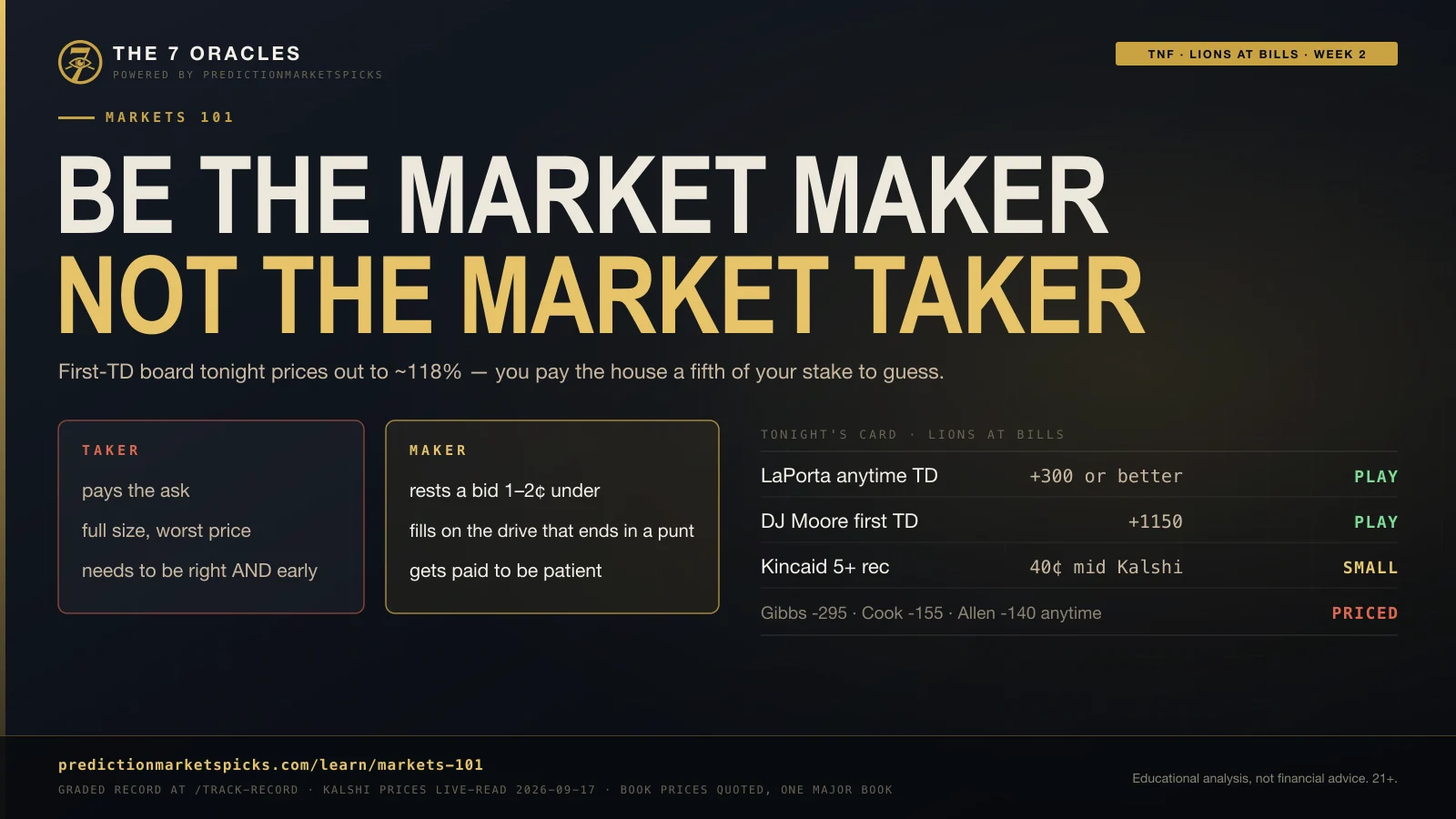
Every market has two seats. The taker pays the ask and gets filled now; the maker rests a bid a cent or two under it and gets filled when someone impatient sells into him. On touchdown markets — which reprice one way, cheaper, every drive that ends in a punt — the maker almost always gets the same contract for less. The first-touchdown board prices out to about 118%, so paying the ask there is paying a fifth of your stake to guess.
Two seats at the table
Every market has two seats. The taker crosses the spread: he sees 38 bid / 41 ask and pays 41. The maker posts his own price: he rests a bid at 38 or 39 and waits for someone impatient to sell into him. Same contract, same outcome, two or three cents of difference. On a market you play fifty times a season, those cents are the entire difference between a winning year and a break-even one.
The books only sell you the taker seat. That’s the whole business model. A prediction market exchange gives you the other chair, and almost nobody sits in it.
Juice is the game, not a footnote
Look at tonight’s first-touchdown market at one major book: Gibbs +290, Cook +550, Allen +700, St. Brown +875, Moore +1150, Jameson Williams +1200, Kincaid +1300, LaPorta +1350, and a dozen more down to +8000. Convert every one of those to an implied probability and add them up. You get about 118% — before you account for “nobody scores” and before defensive or special-teams touchdowns, which are real outcomes that soak up a few more points of probability.
That means the true hold on this market is well north of 20%. You can be dead right about who scores first and still lose money over a season, because you’re paying a fifth of your stake to the house for the privilege of a guess.
Two responses. One: only play the middle and long end of that market, where the vig is spread over a bigger number and a genuine misprice can survive it. Two: stop paying the ask.
Be the maker
Touchdown markets are the easiest place in sports to make rather than take, for a structural reason: they reprice constantly and they reprice in one direction. Every drive that ends without your guy scoring, his ticket gets cheaper. Every incomplete pass, every punt, every sack — all of it walks the price down toward you.
So you don’t need to be early. You need to be patient.
The mechanics, in order:
- Write down your own number before you look at a price. If you think LaPorta scores 28% of the time, your number is +257. Now go look.
- Post a bid a cent or two under the best available price, not at it. On an exchange, that’s a resting limit order. It costs you nothing to sit there.
- Let the game come to you. Kickoff, first possession, a three-and-out — the tickets you want are cheaper at 8:40 than they were at 8:15, unless your guy already scored. If he did, you saved the money you would have spent.
- Size the fill, not the hope. If only half your order fills, that’s a half position, and that’s fine. Half a position at a good price beats a full position at a bad one.
- Know when to quit making. Inactives, a steam move, and the closing minutes before kickoff are taker moments — if the information is already public and the price is running away from you, pay the ask or pass. Being stubborn about a penny while the market moves eight cents is not discipline, it’s ego.
Be the market maker, not the market taker. You can almost always get the touchdown stuff a cent or two cheaper than the screen — even if you have to wait a drive or a few plays to get hit.
Tonight’s worked example — Lions at Bills — Thursday Night Football, Week 2
Kickoff Thu, Sep 17, 8:15 PM ET · the matchup page
The plays
- PLAY
1.Sam LaPorta anytime TD
Anytime touchdown — YES
+300 or betterone major book, 2026-09-17Desk estimate is about 28%, which is +257 fair. The consensus price of +200 is 33% implied and there is nothing there. One book hung +310.
Maker: Post at +320 and wait. If Detroit’s first drive stalls you will get filled better than that.
- PLAY
2.DJ Moore first TD
First touchdown scorer — YES
+1150one major book, 2026-09-17Moore is the actual WR1 in Buffalo: 76% of snaps, a 31.3% adjusted target share and a game-high 19.4 aDOT in Week 1. Desk fair is about +950. The mid-tier of the first-TD list is where the vig is survivable, and this is the one row on the board priced long.
Maker: Rest the order at +1150 and leave it. A first-TD ticket only gets cheaper until someone scores.
- SMALL
3.Dalton Kincaid 5+ receptions
5+ receptions — YES on Kalshi
39 bid / 41 ask (40¢ mid)Kalshi, live read open the contract →Consensus 41.8% (4 books).
Four-book consensus is 41.8% against a 40¢ mid. That was a flagged 5¢ gap at the desk snapshot and has closed to under 2¢ by the afternoon read — at the ask there is nothing here. The only version of this trade that still works is the maker’s.
Maker: Small position, resting bid at 39, not a market order. If it does not fill by the first Buffalo three-and-out, let it go.
What we are passing on
This block matters more than the plays. Every row below is a fine read priced past fair — liking a player is not an edge.
- PASS
4.Jahmyr Gibbs anytime TD
Anytime touchdown — YES
-295one major book, 2026-09-17A fine read priced past fair. Liking a player is not an edge.
Maker: No order at any price the book will show you tonight.
- PASS
5.James Cook anytime TD
Anytime touchdown — YES
-155one major book, 2026-09-17Same story as Gibbs: the likeliest scorer on his side, priced like it.
Maker: No order.
- PASS
6.Josh Allen anytime TD
Anytime touchdown — YES
-140one major book, 2026-09-17Allen scores a lot; the book knows. -140 is fair-to-rich for a quarterback rushing score.
Maker: No order.
- PASS
7.Over 54.5
Game total — OVER
54.5 (opened 51.5)one major book, 2026-09-17The total ran from 51.5 to 54.5 — the over was a play three days ago and is a coin flip now. Our own spread model agrees with -4.5 to within a point, so there is no side either.
Maker: No order. The move already happened; chasing it is the taker seat.
Verify before you fire
DJ Moore 4+ receptions sits at 68 bid / 69 ask on Kalshi (68.5¢ mid) against a 50.7% consensus, which would make the NO at about 31.5¢ the best price on the board. That consensus is only two books deep, so it is a note and not a row. Check his line at a third book first.
Kalshi prices are a live read through our prop-board reader as of Sep 17, 2:20 PM ET and move constantly — the number you see on the exchange is the one that counts. Book prices are quoted from one major book, 2026-09-17; we do not carry a book feed. Educational analysis, not financial advice.
The 60-second version
Quick answers
What is the difference between a market maker and a market taker?
A market taker crosses the spread: he sees a contract at 38 bid / 41 ask and pays 41 to be filled now. A market maker posts his own price instead — a resting bid at 38 or 39 — and waits for someone impatient to sell into it, so the same contract on the same outcome costs him two or three cents less, which over fifty trades a season is the whole difference between a winning year and a break-even one.
Why is the first touchdown market bad value?
Convert every first-touchdown price on the board to an implied probability and the list adds up to roughly 118% before you account for "no touchdown" and defensive or special-teams scores, so the true hold is well north of 20%. You can be right about who scores first and still lose money over a season, because you are paying about a fifth of your stake to the house for the privilege of a guess.
How do I get a better price on an anytime touchdown contract?
Write down your own number before you look at a price, then post a resting limit bid a cent or two under the best available price rather than paying the ask. Touchdown contracts reprice in one direction — every drive that ends without your player scoring makes his contract cheaper — so patience through a punt or a three-and-out usually gets you filled below the screen price, and if he scores first you saved the money you would have spent.
Where the board lives
- NFL player prop prices — Kalshi vs book consensus vs Novig → every strike Kalshi lists this week and where the best price for each side is
- The Ladder — every strike against the model’s distribution → our number is published only inside the 30–70% band where it is measured calibrated
- Probability converter — cents, American odds, devigged fair value → the tool for step one: write down your own number
- The graded record → every published call, settled against the exchange