

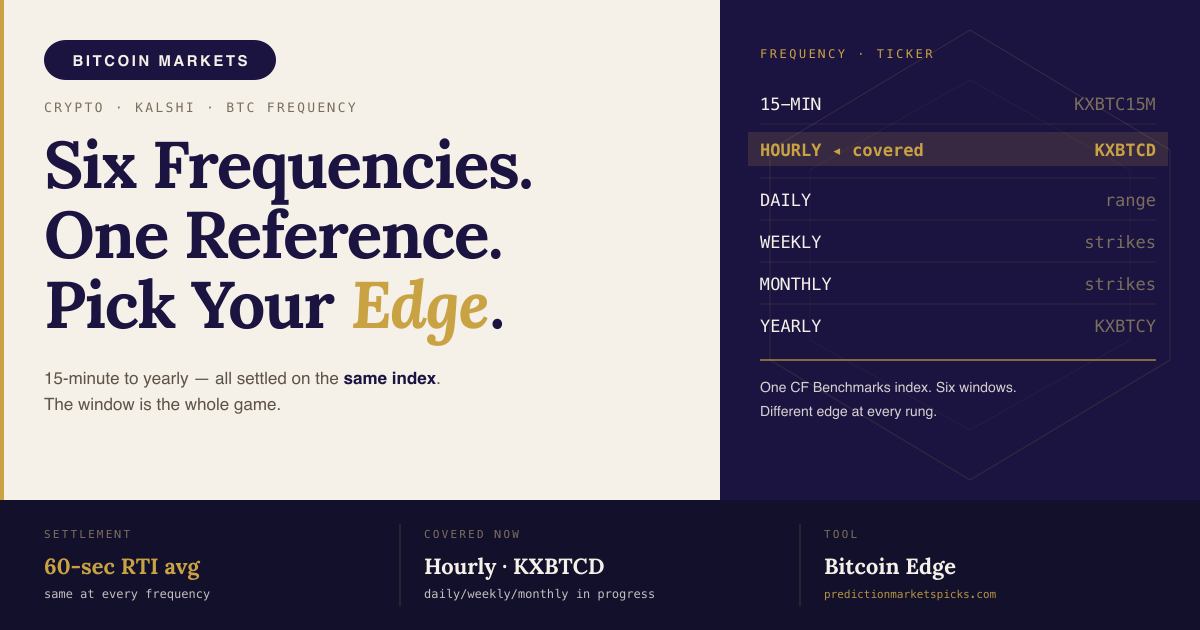
Kalshi doesn't run one bitcoin market. It runs a ladder of them at six different cadences — a new contract every fifteen minutes at the fast end, a single contract spanning the whole calendar year at the slow end. They're all positions on the same asset, settled by the same reference rate. The only thing that changes from one rung to the next is the window: how much time the price has to do something before the contract resolves.
That window is everything. It decides how much the outcome is noise versus signal, how wide the strikes sit, how deep the book is, and — for a trader hunting mispricings — whether there's any edge worth taking. This is PredictionMarketsPicks’ full map of Kalshi's bitcoin frequency taxonomy, the ticker for each rung, and an honest read on which ones are worth your time.
The Short Version
- Six frequencies, one settlement source. 15-minute, hourly, daily, weekly, monthly, and yearly bitcoin contracts all settle on a 60-second average of the CF Benchmarks Bitcoin Real-Time Index. The cadence changes; the reference rate does not.
- Ignore the "BRRNY vs BRTI" framing some guides push. Kalshi's BTC contracts settle on the Real-Time Index family at every frequency — see the settlement breakdown for why that distinction is a myth.
- The window is the whole game. It is why PredictionMarketsPicks’ Bitcoin Edge signals on some rungs and stays dormant on others. A 15-minute contract is almost pure variance; a monthly contract is almost pure drift. Edge shows up at different frequencies for completely different reasons.
- Our tool covers the hourly rung today (Bitcoin Edge, KXBTCD, 10 AM–4 PM ET) because that's where an IBIT options chain gives a clean second opinion. Daily/weekly/monthly coverage is in progress; the 15-minute rung needs a different model entirely.
The Frequency Ladder
Kalshi organizes its crypto markets by frequency — the same taxonomy you see on its own crypto category pages. Here's the bitcoin ladder, fastest to slowest:
| Frequency | Example ticker | Contract question | Window | Strikes |
|---|---|---|---|---|
| 15-minute | KXBTC15M | Will BTC be up or down at the close of this quarter-hour? | 15 min | Single up/down pivot |
| Hourly | KXBTCD | Will BTC be above $X at the top of the hour? | ≤ 60 min | Above/below ladder |
| Daily / range | KXBTC | What price range will BTC be in at a set time today? | Hours | Range buckets |
| Weekly | weekly KXBTC series | Will BTC be above $X this Friday? | ~1 week | Above/below ladder |
| Monthly | monthly KXBTC series | Will BTC be above $X at month end? | ~1 month | Above/below ladder |
| Yearly | KXBTCY, KXBTCMAXY, KXBTCMINY | Will BTC be above $X / hit a max / hit a min this year? | ~1 year | Wide above/below |
> Verify the live ticker before you trade. Kalshi rotates and renames series as products evolve. The patterns above are stable, but always confirm the exact series_ticker on the live market page or via markets?series_ticker=… rather than trusting a contract code from an old guide.
The shape of the question changes as you climb. At 15 minutes, there's barely room for a strike ladder — the market is essentially "up or down from here," a coin-flip the contract prices a few cents off 50/50. By the time you reach the yearly rung, the question is a wide directional position on where bitcoin lives twelve months out, and the strikes fan out across tens of thousands of dollars.
Same Reference Rate at Every Rung
Here's the single most misunderstood fact about these markets, and the one competing explainers consistently fumble: every bitcoin frequency on Kalshi settles on the same reference rate.
Kalshi's own documentation is explicit — all crypto contracts resolve by averaging 60 seconds of the relevant CF Benchmarks Real-Time Index, sampled once per second over the final minute before the window closes. A 15-minute contract and a yearly contract use the same index; they just average it at different moments. There is no separate "15-minute index" and no daily-fixing rate quietly swapped in for the longer-dated contracts.
That matters for two reasons. First, it means your spot reference can be consistent across every frequency you trade — you're never modeling a different underlying just because you moved up a rung. Second, it kills a common confusion: some third-party guides claim the short-dated contracts settle on one CF Benchmarks product and the longer ones on another (the "BRRNY vs BRTI" story). They don't. We break down exactly why in How Kalshi Settles Bitcoin.
Where the Edge Lives at Each Frequency
The window determines the kind of edge available, and whether you can price it at all.
15-minute (KXBTC15M): variance, not direction
Over fifteen minutes, bitcoin's expected move is tiny relative to its volatility. The outcome is dominated by noise, so the contract sits close to 50/50 and the edge — if any — is microstructure: order-flow imbalance, short-window realized volatility, the occasional liquidity air-pocket. You cannot price this off an options chain; there's no listed option that short-dated. It needs a purpose-built short-horizon model. Full mechanics in Kalshi Bitcoin 15-Minute Markets.
Hourly (KXBTCD): the options-chain sweet spot
The hourly rung is where we fire today. For roughly an hour of clock time, there's enough room for a real strike ladder, and — critically — the IBIT options chain on the same underlying gives an independent, professionally-calibrated probability for "BTC above $X." When Kalshi's retail-driven hourly book diverges from that options-implied number by more than trading costs, that gap is the trade. That's the entire thesis behind Bitcoin Edge, and why we only run it during the 10 AM–4 PM ET window when the chain is live.
Daily & weekly: drift starts to matter
Push the window out to a day or a week and directional drift, funding, and scheduled catalysts (CPI prints, FOMC, ETF flow) start to outweigh pure variance. These map cleanly onto IBIT's weekly and monthly option expiries, so the same options-implied model that powers the hourly rung extends here with a different expiry selection — the cheap engine win we're building next.
Monthly & yearly: macro positioning
At a month or a year, you're no longer trading microstructure — you're taking a view on bitcoin's path. Edge here is fundamental and slow: where the options market's term structure disagrees with Kalshi's longer-dated strike ladder. Lower turnover, wider strikes, and a holding period measured in weeks. Size these as positions, not trades.
A Practical Decision Tree
Which rung should you be on? Match the frequency to what you actually have an edge in:
- You read order flow and can sit at the screen. The 15-minute rung is your arena — but go in knowing it's a microstructure game, not a price-prediction one, and the house edge (spread + fees) is brutal on a 15-minute hold.
- You want a model-backed signal with a clean second opinion. The hourly rung, during US options hours, is the only frequency where an independent options chain prices the same question. Start at Bitcoin Edge.
- You have a directional view over days to weeks. Daily and weekly contracts let drift and catalysts work for you, with deeper books than the 15-minute scramble.
- You're positioning on bitcoin's macro path. Monthly and yearly contracts. Treat them like the term trades they are — size small, hold long, and use the Kelly calculator at a fraction.
How Bitcoin Edge Maps to the Ladder
We're honest about which rungs we cover. Today, Bitcoin Edge prices the hourly KXBTCD rung — the seven settles per weekday between 10 AM and 4 PM ET when the IBIT options chain is open. That's not the whole ladder; it's the rung where a clean, independent probability exists.
The roadmap follows the pricing reality, not the keyword map:
- Hourly — live now. Options-implied probability vs the Kalshi book.
- Daily / weekly / monthly — in progress. Same options model, longer IBIT expiries. These don't need the overnight pause the hourly rung does, since longer-dated implied volatility is stable.
- 15-minute — research. A genuinely different model (short-window realized volatility + momentum), because no listed option is that short-dated.
We'd rather cover one rung honestly than slap a "multi-frequency" badge on a tool that's really only pricing one window. As each rung comes online, it'll show up on the tool with its own honest empty-state until there's real data behind it.
The Same Ladder Now Exists in Metals
Bitcoin isn't the only asset Kalshi runs at multiple frequencies any more. Gold and silver now have both a weekly strike ladder (KXGOLDW / KXSILVERW, priced against an options-implied view at Gold Edge and Silver Edge) and a 15-minute up-or-down window (KXGOLD15M / KXSILVER15M, priced live at Gold Edge 15-Min and Silver Edge 15-Min).
The frequency logic from this article carries over intact — longer windows let an options chain do the work, short windows don't — with one twist in the metals' favour: they settle on Pyth candle closes, the exact feed we already poll, so the 15-minute rung there is priceable in a way the bitcoin one isn't. The metals breakdown covers the settlement mechanics and the fee math.
FAQ
How many bitcoin market frequencies does Kalshi have?
Six: 15-minute, hourly, daily, weekly, monthly, and yearly. They are all contracts on the same underlying bitcoin price, differing only in the window over which the outcome is measured.
Do different Kalshi bitcoin frequencies settle on different reference rates?
No. Every frequency settles on a 60-second average of the same CF Benchmarks Bitcoin Real-Time Index, sampled once per second over the final minute before the window closes. The "BRRNY for short-dated, BRTI for longer" framing some guides use is incorrect — see How Kalshi Settles Bitcoin.
Which Kalshi bitcoin frequency has the best edge?
It depends on your edge, not the market's. The hourly rung is the only one where an independent options chain prices the same question, which is why our tool covers it. The 15-minute rung is a microstructure game; daily through yearly reward a directional or macro view.
What's the ticker for Kalshi's 15-minute bitcoin market?
KXBTC15M for the up/down quarter-hour contracts. The hourly above/below market is KXBTCD; the yearly markets include KXBTCY, KXBTCMAXY, and KXBTCMINY. Always confirm the live series ticker on the market page before trading.
Can I price the 15-minute market with options?
No. There's no listed option that short-dated, so the options-implied method that powers the hourly tool doesn't apply. Short-horizon pricing needs a realized-volatility-plus-momentum model — covered in the 15-minute markets article.
Use The Tool
Bitcoin Edge prices the hourly rung in real time during US options hours — the strike table, the edge in percentage points, the buy/sell signal, and the confidence tier. Pro subscribers get the full board plus the Discord drop when a high-conviction call fires.
Six frequencies, one underlying, one reference rate. The rung you trade should match the edge you actually have — not the one with the catchiest contract code.
Trade responsibly. Position size based on your edge and your account, not on excitement. Prediction-market contracts on Kalshi are regulated by the CFTC.