

Let me start with the part I actually disagree with, because it is everywhere and it is lazy.
People say LeBron James cherry-picks his teams. I don't think that's true at all. LeBron James is the cherry. He's not picking the contender — wherever he goes, that's the swing. If he'd gone to the Knicks, everybody says the Knicks are winning it again. Cleveland, and Cleveland's a Finals team. Miami, they've got a chance. Boston, they've got a chance. Philly, he's got a chance.
What do people actually want here? They want him to sign with the Magic so the take feels fair?
That's the argument. Now here's why I'm writing it up instead of leaving it on the timeline: the market settles this debate in dollars, and it has settled it four separate times. You don't need a take. You need a price history.
The Receipts: Four Moves, Four Repricings
Every time LeBron has changed teams, the destination was not a contender the day before. Here is what each franchise was priced at before he signed and immediately after, using the same source on both sides of the move so we're comparing apples to apples:
| Move | Before | After | Swing |
|---|---|---|---|
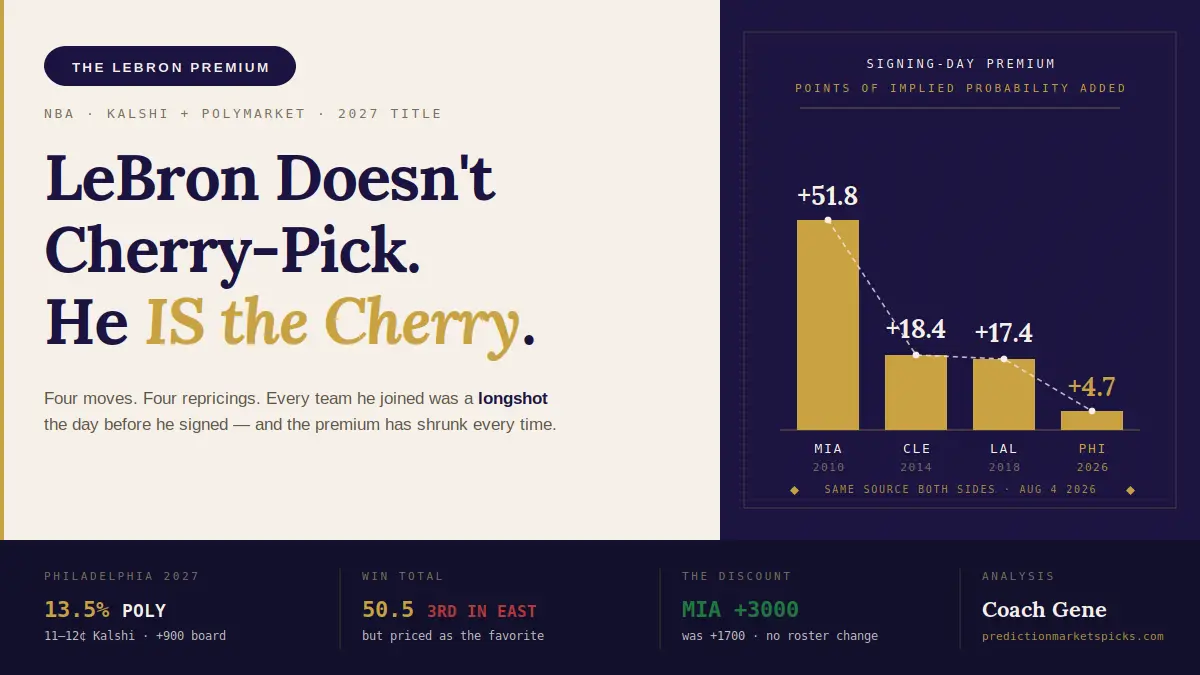
| Miami, July 2010 | 25-1 (3.8%) | 4-5 (55.6%) | +51.8 pts |
| Cleveland, July 2014 | 60-1 (1.6%) | 4-1 (20.0%) | +18.4 pts |
| Lakers, July 2018 | +2000 (4.8%) | +350 (22.2%) | +17.4 pts |
| Philadelphia, July 2026 | +2000 (4.8%) | +950 (9.5%) | +4.7 pts |
Read the "before" column one more time. 25-1. 60-1. +2000. +2000. Nobody cherry-picks a 60-1 team. That is a franchise coming off 33-49 and no playoffs, which is exactly what Cleveland was in the spring of 2014. Philadelphia was 12th in the league at +6000 in mid-June of this year.
The pattern under the numbers is even better than the numbers. Miami went 47-35 the year before he arrived and 58-24 the year after. Cleveland went 33-49 and then 53-29. The Lakers were 35-47 and then, two years in, 52-19 and a title. He shows up, and a lottery team is suddenly on the schedule of teams that matter. That is not picking the cherry. That is being it.
The Part Nobody Is Writing About: The Premium Is Shrinking
Look down that swing column again: +51.8, +18.4, +17.4, +4.7.
That is not noise. That is a market that has been repricing the same input for sixteen years and has gotten progressively less impressed each time. In 2010 the market moved a franchise from a 3.8% shot to the outright favorite in a single afternoon. In 2026 it moved one by less than five points and left it fourth on the board.
Two things are inside that decline, and they matter differently.
The first is age, and it is honest. He's 41, he turns 42 on December 30, and he'll be 42 for the entire 2027 postseason. Last season he played 60 games, averaged a career-low 20.9 points on a career-low 26.2% usage, shot 31.7% from three, and had more than half his field goals assisted for the first time in his career. That's still a very good player. It is not the 2010 input, and the market is right to price it differently.
The second is that the market simply got smarter about star signings generally, and that's the transferable lesson. Ohtani to the Dodgers in December 2023 moved the World Series price from +700 to +550 — under three points. One player is a smaller share of a baseball team, sure, but the general reflex to slam the price on a headline has gotten more disciplined across every sport. If you're modeling the next superstar move, the 2010 comp will lie to you badly. Use the recent ones. That's just base-rate discipline applied to a market instead of a matchup.
What "Being the Cherry" Actually Looks Like on a Screen
Here's my favorite number in this whole story, and it's the one that proves Gene's point better than any odds move.
On Kalshi, the Philadelphia contract in the 2027 title market has traded about 5.49 million contracts. The next-busiest team in that entire market is at roughly 2.14 million. The two co-favorites — Oklahoma City and San Antonio, the teams actually most likely to win the thing — are around 450,000 and 368,000 each.
Philadelphia is not the favorite. Philadelphia is twelve times the volume of the favorite.
And the destination market — the "where will LeBron sign" contract itself — moved north of $226 million in traded volume before he'd played a minute for anybody. He doesn't just move a price. He creates the market. That's the cherry, quantified.
The Market Was Badly Wrong About Where — and Fast About What
Worth pausing on, because it tells you what these markets are good at and what they're not.
At 11:00 a.m. ET on announcement day, hours before the news landed, Kalshi had Philadelphia fourth at 8.9%, behind Miami at 45% and Cleveland at 43%. Two hundred and twenty-six million dollars of volume, and the crowd had it wrong on the actual destination — badly.
Then the news hit and the 76ers were repriced correctly-ish within minutes.
That's the whole lesson about what a crowd is: prediction markets are excellent at pricing consequences and lousy at pricing decisions that live inside one man's head. No amount of liquidity gets you inside LeBron James's kitchen-table conversation. The moment the information exists, the market is superb. Before that, it's a very expensive poll. Keep that straight and you'll stop paying for the second thing while thinking you're buying the first.
Our Own Scorecard, Eleven Days Later
On July 25 we published Fade the Bump. Here is the honest grade, because a track record you only publish when it's flattering isn't a track record.
On Kalshi, the fade paid. The contract spiked to 19 cents intraday on announcement day and has sat at 11-12 cents since. Anybody who sold that spike is well ahead.
On the oddsboard, it hasn't. Philadelphia was +900 the day of the signing and is still around +900 eleven days later. BetMGM's own trading manager told VegasInsider on July 24 that he expected the number to "drift back out, likely settling closer to the +1200 range." It hasn't. Even the house's forecast of its own market missed.
Polymarket splits the difference: it printed 13.35% right after the news, peaked at 14.35% on July 27, bottomed at 12.45% on August 3, and sits around 13.5% today. That August round-trip has no news attached to it — no Embiid update, no roster move. That is position unwinding, not information.
Same event. Three venues. Three different outcomes. If you take one operational thing from this piece, take that one: the fade was a venue call, not a market call. And there's still a live spread on an identical contract right now — Kalshi 11-12 cents against Polymarket at 13.5% — which is exactly the kind of gap you should be running through the Probability Converter before you assume "the price" is one number.
So Where's the Trade?
I agree with the take and I still won't buy the team. Those are two different questions and conflating them is how people lose money agreeing with themselves.
Why I'm not buying Philadelphia at 13.5%:
The regular-season market and the futures market are openly contradicting each other. Philadelphia's win total is 50.5 — as low as 48.5 in places — which is third in the East, behind New York at 52.5 and Boston at 51.5. Meanwhile the futures market has them at or near the top of the conference. A team the win-total market ranks third cannot also be the conference favorite. One of those two numbers is wrong, and I don't need to know which one to know I don't want to pay the higher of the two.
Then there's the availability problem, which is the actual bear case and always has been. Joel Embiid played 38 games last season and 57 across the last two combined. The encouraging note is real — Rich Paul says this is the first genuinely healthy summer Embiid has had, no surgery — but "healthy in July" is a sample size of zero. Pair that with a 42-year-old playing point guard and you are buying two availability lottery tickets and calling it a roster. LeBron's own agent said it out loud days after the signing: "The Sixers aren't favorites to win it all." When the player's representative is talking the price down, listen.
Where I think the money actually is: the mirror side.
Everybody watches the premium. Almost nobody watches the discount. When LeBron picked Philadelphia:
- Miami went from roughly +1700/+1800 to +3000. They did not lose a player. They did not trade anyone. They signed Giannis Antetokounmpo this offseason and that was already in the +1700. The entire move is the market's disappointment at losing a free-agent race.
- Golden State went +3000 to +6000. Same story. Nothing happened on a basketball court.
- Cleveland went +2000 to +2500.
That is a market marking down three rosters for something none of them did. Miami is priced around 3-4% on both venues today with a roster that was worth nearly double that eleven days ago and hasn't changed. I'm not telling you Miami wins the East. I'm telling you the reason for the markdown is emotional, it's checkable, and it is the single most reliable pattern in this entire sixteen-year data set: the LeBron premium always has a LeBron discount attached to it, and the discount is the cheaper side of the same trade.
How I'd Play It
- Pass on Philadelphia at 13.5% Polymarket / 11-12 cents Kalshi. The thesis is fine; the price already has it.
- Look at the jilted. Miami at 3-4% and Golden State at the widened number are markdowns with no roster event behind them. Build your own number first — if you can't get there independently, it's not an edge, it's a story.
- Watch the win-total gap. If Philadelphia's total climbs toward New York's while the conference price holds, one of those markets is capitulating. That's your signal about which one was wrong.
- Sizing: quarter-Kelly, maximum. A 2027 contract holds your capital until next summer and can't settle early. Run the number in the EV Calculator, then size in the Kelly tool, then cut it. Nobody has ever been hurt by being small on a ten-month hold.
- What kills the fade: Embiid clearing 65 games. That's it. That's the whole list. If he's available in April, today's Philadelphia price ages beautifully and I'll say so in print.
LeBron doesn't cherry-pick. He's the cherry — the price history proves it four separate times, and the shrinking size of that premium is the most interesting number in the file. But being the cherry is precisely the reason you don't buy him at the top of the move. The market has already paid him the compliment. Your job is to find who it insulted on the way.
Go get the discount.
— Coach Gene
All prices as of August 4, 2026 and quoted from live markets — check the current board on Kalshi or Polymarket before entering anything. Market analysis, not financial advice.
For daily prediction market picks and the full 7 Oracles analysis, subscribe to our newsletter or upgrade to Pro for real-time Discord edge alerts.