

Every August the same thing happens. EA drops Madden ratings, a few dozen players complain about their speed number on social, the takes fly, and then everyone forgets about it by Week 1. The ratings get argued about constantly and measured almost never.
So we measured them.
We pulled every Madden launch roster from 2006 through 2025, built team-strength composites out of them, and tested those composites against 4,237 real NFL games — straight-up, against the closing line, and week by week. No cherry-picking, no hindsight. Here's exactly how much signal is actually in a Madden rating.
Want the live version? Our NFL model is built on play-by-play, not Madden — we tested folding this in and the fitted weight came out zero (see the FAQ below). The current NFL market reads and edges are on the Sports board.
How we ran it
The honest version of a backtest matters more than the number it produces, so here's the method in plain English:
- Data. Madden launch ratings 2006–2025 (the open-source nfl-madden-data project, joined to nflverse player IDs) plus every game result and closing spread from nflverse. Roughly 20 seasons.
- Team composites. For each team-season we built depth-weighted unit ratings — quarterback, offensive line, pass rush, secondary, and the rest — from the top-rated starters at each position. That rolls up into one team overall.
- Kill the drift. A Madden 88 in 2012 is not a Madden 88 in 2024 — the whole scale inflates over time. So every composite is z-scored within its own season. We're only ever comparing a team to its peers in the same edition.
- Walk-forward, no leakage. To predict a season, we train only on seasons that came before it — a logistic model for win probability and a linear model for margin — then advance one year and repeat. Nothing about 2020 ever touches a 2015 prediction. This is the same discipline behind our Gridiron Edge NFL model.
That gives us out-of-sample predictions for 2010–2025 that never saw their own answers.
The headline numbers
| Metric | Madden-only model | Benchmark |
|---|---|---|
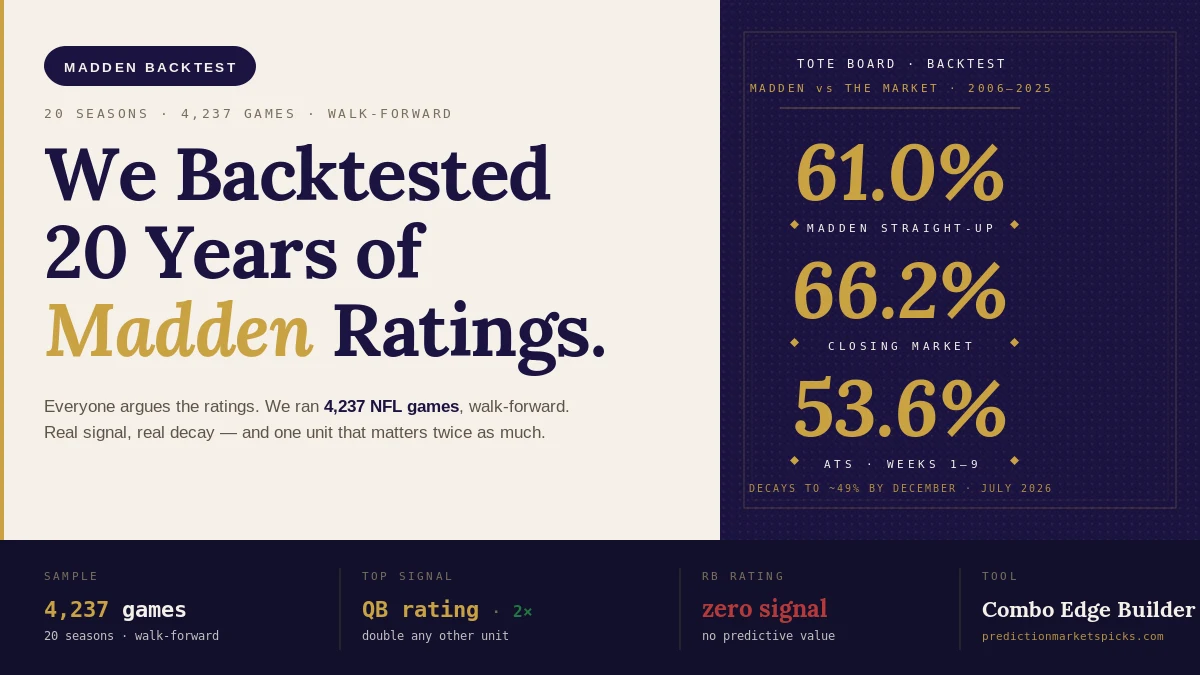
| Straight-up accuracy | 61.0% | Closing market line: 66.2% |
| Against the closing spread | 51.3% | Breakeven: 52.4% |
| Brier score (lower = better) | 0.232 | Closing line: 0.212 |
| Preseason composite vs actual wins | r = 0.44 | — |
Read those honestly and a clean story falls out. A free preseason prior gets you 61% of games straight-up and a Brier score about 90% of the way to the closing line. That is genuinely more signal than most people assume is sitting in a video game's overall ratings.
But it does not beat the market. The closing line is better on every axis, and against the spread the full-season number sits just under breakeven. If your plan was to print money off Madden ratings, the data says no.
Want the 2026 edition? The Madden 27 numbers for all 32 teams — EA's composite next to our own power ratings and live Kalshi win-total prices — are on the Madden 27 ratings board. We also ran the season ten thousand times off nothing but those ratings to see which teams the game likes and the market doesn't.
The interesting part is where the signal hides.
The edge is an early-season thing
Split the against-the-spread results by part of the season and the flat 51.3% breaks apart:
| Stretch | Straight-up | Against the spread |
|---|---|---|
| Weeks 1–4 | 60.1% | 53.6% |
| Weeks 5–9 | 63.1% | 53.6% |
| Weeks 10–13 | 58.5% | 48.8% |
| Weeks 14–18 | 61.9% | 49.1% |
| Playoffs | 59.7% | 50.3% |
In the first half of the season, Madden-only picks clear the 52.4% breakeven against the closing line. By the back half they fall apart. That is exactly what you'd expect and exactly what sharp traders have quietly said for years: Madden ratings are a bottom-up talent snapshot, most valuable before the market has real 2026 football to price. Once games pile up, live information swamps the preseason prior and the edge evaporates.
If there's one chart to take away, it's that one. The Madden edge lives in Weeks 1 through 9.
QB is almost the whole story
When we let the model weigh the individual position units, the ranking was lopsided:
- Quarterback — coefficient roughly double the next unit
- Secondary
- Pass rush
- Linebacker / offensive line (a near-tie)
- Receiver / tight end
- Running back — essentially zero, slightly negative
Quarterback rating carries the load, and running back rating carries almost none — a result that independently replicates the best prior academic work on Madden ratings. The market has known for a decade that quarterback play dominates NFL outcomes; it's a nice confirmation that the same truth is legible inside Madden's own numbers, and a reminder that a gaudy running back overall doesn't move the needle.
It's well-calibrated
One more thing worth saying because it's rare: the model is honest about its own confidence. When it said a team had a 60% chance to win, those teams won about 60% of the time; 70% meant roughly 70%. The predicted probabilities track the actual win rates almost straight up the diagonal. A well-calibrated 61% model is far more useful than an overconfident 63% one — you can trust the number, not just the pick.
So what is it good for?
Not a money machine. A free, surprisingly decent prior — and priors are most valuable exactly where every NFL model is weakest: the first few weeks of the season, before injuries and depth charts have shaken out and before there's any 2026 tape to lean on.
That's precisely how we use it:
- Model input — tested, and deliberately not shipped. The obvious move was to blend the Madden composite into our power ratings for the opening weeks and decay it to zero by Week 5. We fitted that weight over 947 games (Weeks 1–4, 2010–2024) against our own preseason model. It didn't clear the bar: the best weight moved Brier by +0.0007 with a bootstrap confidence interval straddling zero, and results against the closing spread got worse as the weight rose. So the fitted weight is zero. That is a statement about our model, not about Madden — its composite predicts wins fine standalone, it simply doesn't tell a play-by-play prior anything new. Shops that do lean on Madden in the opening weeks are usually blending it into a thinner base, which is a different question. Worth re-running on a bigger sample: at 947 games we could not have detected an effect much smaller than the one we were chasing. Full sweep journaled in the repo.
- Weekly signal. Because EA ships roster and ratings updates all season, a jump or drop in a team's Madden composite is a free, injury-aware talent read. We track those weekly moves against live Kalshi contract prices and flag where the roster update and the market disagree.
- Sanity check. Before you build a same-game NFL position, it's worth knowing whether the underlying talent even supports the price. Run the legs through the Combo Edge Builder and convert any American odds you're comparing with the Probability Converter.
Credit where it's due: this one was Dylan Ricciardi's idea. Our intern pitched the backtest, and the result came back better than either of us expected going in — not a crystal ball, but a real, measurable, free edge sitting in plain sight every August, strongest in the exact window when everyone else is flying blind.
Ready to put it to work? The 2026 ratings are live on the Madden 27 board, the 10,000-season simulation turns them into win totals and title odds, and live NFL market reads and model edges are on the Sports board →