

Kalshi has officially gone too far.
The prediction market that let you trade elections, the Oscars, and whether it rains in Central Park now lists contracts on flight cancellations. Real markets. Real money. Real dollars riding on whether America's airports hold it together this week.
Then I opened the actual market. And it is not the thing the headlines are selling you.
I said most of what I needed to say in the video. Watch it, then let's get into what these contracts actually are.
▶ Watch on its own page, with the full transcript →
What Kalshi Actually Listed
This is the part most of the coverage is getting wrong, my own first take included.
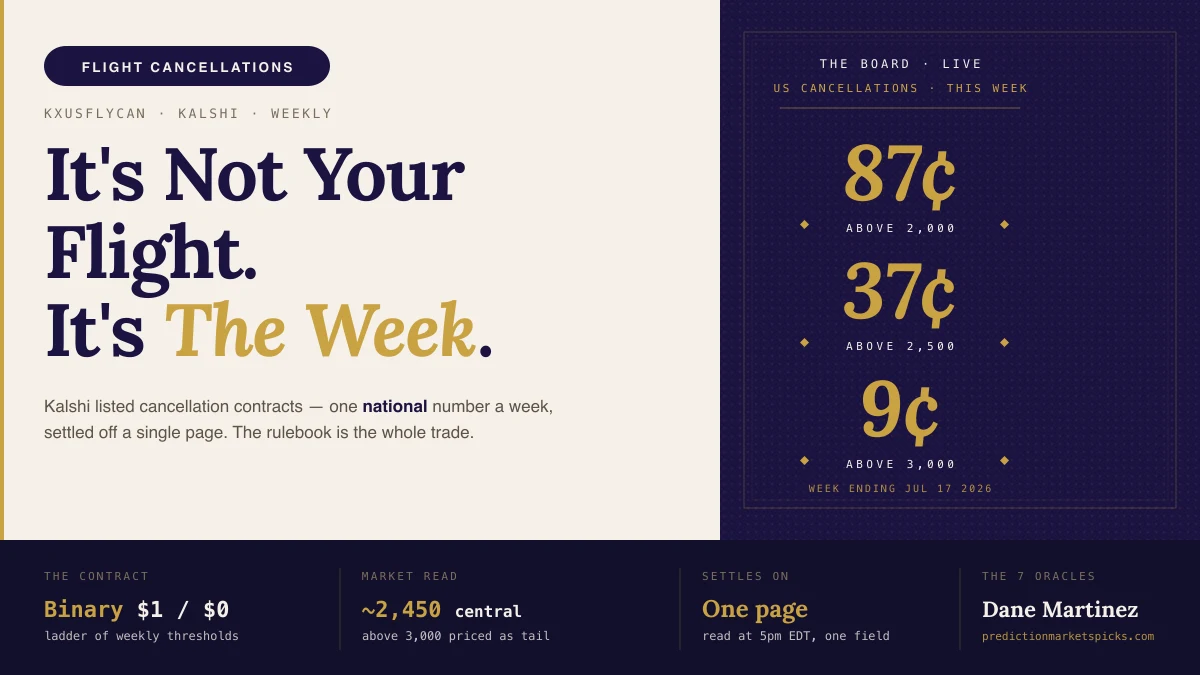
The live contract is KXUSFLYCAN — "US flight cancellations this week." Read that again. Not delays. Not your airport. Not your flight. It is one national number: total cancellations within, into, or out of the United States over a defined week.
Kalshi self-certified it as a CFTC-regulated event contract. "Self-certified" means Kalshi files the contract with regulators and it goes live unless the CFTC objects. That is the standard process, not a loophole.
The mechanics are the same as every other Kalshi market:
- Each contract is binary — it pays $1 if the event happens, $0 if it doesn't
- It's a ladder of thresholds, not one market. "Above 2000," "above 2500," "above 3000," and so on
- You take the YES side if you think cancellations clear that threshold, NO if you don't
- The week ends at a fixed observation time, and the exchange reads one number
The first week opened July 11 and settles for the week ending July 17.
What the Board Says Right Now
Here's the live ladder, and it tells you exactly what the market thinks:
| Threshold | YES price | What it means |
|---|---|---|
| Above 2,000 | 87¢ | Near-lock. This is a normal week's floor |
| Above 2,500 | 37¢ | The real question |
| Above 3,000 | 9¢ | Needs a bad week |
| Above 3,500 | 5¢ | Needs a system event |
| Above 4,000+ | 1–2¢ | Needs a meltdown |
Read the ladder and you get the market's whole forecast for free: it's pricing a central estimate around 2,400 to 2,500 cancellations for the week. Everything above 3,000 is priced as tail. That's a market saying "this will be a boring week," which is exactly what most weeks are.
If you've never read a price ladder like this before, start here — a strike ladder is a probability distribution wearing a disguise.
The Part Where I Panic (Briefly)
You mean people can take a YES position on cancellations… and then go cause a cancellation?
I don't want to be sitting at the gate and find out the guy next to me has a hundred large riding on this plane not leaving on time. That's not a market, that's a hostage situation with a bid-ask spread.
I'm mostly kidding — and here the national-aggregate design is the point. It takes over 2,000 cancellations to reach the bottom rung of this ladder. One guy with a checked bag full of hopes isn't moving that. He isn't moving it with a hundred guys. Regulators require these outcomes to be objective, verifiable, and not readily susceptible to manipulation, and a number built from every commercial flight in American airspace clears that bar comfortably. Weather and air traffic control move it. Nobody at your gate does.
But the incentive conversation is still real, and it's the same one Kalshi has been having with the CFTC all year. When event contracts start touching everyday consumer experiences — your flight, your commute, your morning coffee — the line between hedging and rooting for chaos gets thin. Worth saying out loud, even when the math says relax.
The Case FOR These Markets
Rant hat off, because there's a legitimate use here — it's just not the one people assume.
Flight disruption costs travelers and businesses billions every year. A contract that pays out when cancellations spike is a hedge against systemic travel risk. But be precise about who that actually serves: a national weekly count is a macro hedge. It's useful to an airline, a travel insurer, a corporate travel desk, or an online travel agency with thousands of itineraries exposed to the same bad week.
It is not insurance for your 6:40am to Tampa. Your flight can get cancelled during the calmest week on record and this contract pays you nothing. Anyone selling this as "DIY travel insurance for your trip" hasn't read the contract. The exposure is to the system having a bad week, not to you having a bad day.
That's the same logic as a farmer hedging crop prices rather than insuring one field. It's just weirder because the underlying is collective misery.
Where the Edge Actually Is: Read the Rules, Not the Headline
This is the part I'd actually spend time on, and it has nothing to do with airports.
Here's the real settlement rule, verbatim from the contract:
> The relevant value is the number shown in the field labeled "Total cancellations within, into, or out of the United States this week" on FlightAware's live weekly delay and cancellation page at the time of observation. This market resolves based on that figure as checked by the Exchange at 5pm EDT.
That's the whole game, and it's more specific than "official flight data from aviation authorities." It is one vendor's live web page, one named field, read at one moment. Three things fall out of that:
- Your data source and the settlement source are the same thing, and it's free. You don't need a model. You need the page the exchange is going to read. Most traders in a new market never check.
- The observation is a snapshot, not a total. A live counter checked at 5pm EDT is whatever that page says at 5pm EDT. Late-reporting flights, revisions, and the exact reset behavior of a weekly counter are the mechanics that decide close calls — not your weather read.
- Weather and ATC staffing are the only real drivers, and forecasts are public days ahead. That's your base rate work: historical weekly cancellation counts by season, against this week's actual system stress.
Every new Kalshi market runs the same life cycle. It launches, tourists price it on feelings, and people who read the resolution criteria eat first. This one is barely a week old, and its rulebook is doing more work than its subject matter. Run your read through an expected value check and size it properly before you get cute with a 1¢ tail.
That's exactly the kind of thing we do at PredictionMarketsPicks — free tools, real numbers, and the edge on whatever Kalshi lists next. Elections, sports, weather, and now, apparently, whether the sky works this week.
Just do me a favor: make your money on the data, not by unplugging the jet bridge.
Kalshi's US flight-cancellation series (KXUSFLYCAN) settled its final contract on August 14, 2026 and is no longer listed — see what's trading on Kalshi now.
FAQ
Are Kalshi's airport delay markets legal?
Yes. Kalshi is a CFTC-regulated designated contract market, and these contracts were filed through the standard self-certification process, under which a contract goes live unless the CFTC objects. The CFTC retains authority to review.
Are they delay markets or cancellation markets?
Cancellation markets. Despite how they've been described, the live contract (KXUSFLYCAN) tracks total US flight cancellations over a week. Kalshi has listed per-airport contracts too, but at the time of writing the live, trading market is the national weekly cancellation ladder.
How do Kalshi's flight cancellation contracts settle?
On a single figure — total cancellations within, into, or out of the United States for the week — read from FlightAware's live weekly delay and cancellation page, checked by the exchange at 5pm EDT on the settlement date. Each contract pays $1 if the threshold is met, $0 if not.
Can someone manipulate a flight cancellation market?
Realistically, no. The lowest threshold on the ladder is over 2,000 cancellations nationwide. A single delayed or cancelled flight is a rounding error against a number built from all US commercial traffic, and regulators require these outcomes to be objective, verifiable, and resistant to manipulation.
Can I hedge my own flight with these markets?
Not meaningfully. This is a national weekly count, so it pays when the system has a bad week, not when your flight gets cancelled. It's a macro hedge for someone with broad exposure — an airline, a travel company — not trip insurance for one itinerary.
What is the ticker for Kalshi's flight cancellation market?
KXUSFLYCAN, listed under Economics as a weekly series. Each week is its own event with a ladder of thresholds.
Dane Martinez (@spittinspeedz) covers prediction markets for The 7 Oracles. Free tools and market reads at PredictionMarketsPicks.