

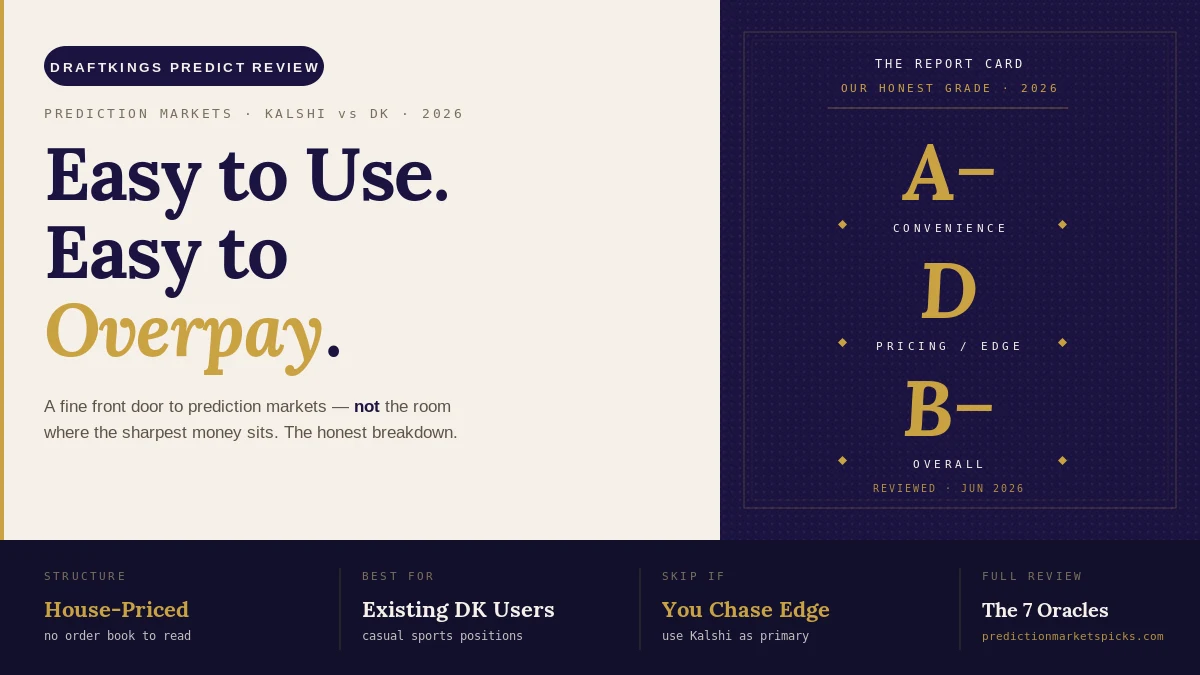
DraftKings entered the prediction market space from an unusual angle — as an established sports giant with existing customer relationships, brand recognition, and licensed infrastructure across dozens of US states. The question is whether that background translates into a competitive prediction market product. The honest answer: sometimes yes, often no, and it depends entirely on what you are trying to do.
This is a no-spin review. We run prediction-market tools for a living, we hold positions on Kalshi and Polymarket, and we have no incentive to tell you DraftKings Predict is something it is not. Here is the real breakdown.
What DraftKings Predictions Actually Is
DraftKings Predict is a prediction market product offering binary YES/NO contracts on sports and select non-sports events. Unlike Kalshi (which is CFTC-regulated as an exchange) or Polymarket (which is blockchain-based), DraftKings Predict operates under DraftKings' existing state gaming licenses. That means availability varies by state and the regulatory framework is different from what governs Kalshi.
The interface will feel immediately familiar if you have used DraftKings before — which is intentional. DraftKings is trying to capture its existing user base with a new product, not necessarily attract sophisticated prediction market traders away from Kalshi. Understanding that strategy explains almost every design decision the product makes.
How DraftKings Predict Actually Works: House Pricing vs. an Exchange
This is the single most important thing to understand, because it changes the math on every position you take.
On a true exchange like Kalshi, you trade against other participants. Prices are discovered through an open order book — buyers and sellers meet, and the last traded price reflects the crowd's real-time probability estimate. You can see depth, you can see where size is sitting, and you can place resting orders to get filled at your price.
DraftKings Predict, by contrast, sets prices. You are trading against DraftKings' pricing model, not a competitive order book. The margin is built into the spread at the house's discretion, and there is no order flow to read. For a casual participant this is invisible. For anyone trying to extract an edge, it is the whole ballgame — you cannot beat a market you cannot see into.
DraftKings Predict vs. Kalshi vs. Polymarket
| Factor | DraftKings Predict | Kalshi | Polymarket |
|---|---|---|---|
| Structure | House-set pricing | CFTC-regulated exchange (order book) | Decentralized, crypto-based |
| US access | States with DK gaming licenses | Nearly all 50 states | Polymarket US since Dec 2025, state by state (international book closed to US persons) |
| Price discovery | Set by the house | Open order book | Open order book |
| Market breadth | Sports-heavy | Sports + macro + politics + econ | Broadest, global |
| Macro / politics | Thin | Deep | Deep |
| Funding | Existing DK balance / card | USD, bank, FDIC-eligible | Crypto (USDC) |
| Best for | Existing DK users, casual sports | Serious US traders wanting edge | Crypto-native, global events |
The table makes the positioning obvious: DraftKings Predict is a convenience product for people already inside the DraftKings ecosystem. It is not built to be the sharpest venue in the room, and it does not pretend to be.
Pros
State availability. DraftKings has an established presence in most US states where its products are legal. That gives it geographic reach newer platforms are still building toward. If you are in a state where Kalshi is not yet fully operational, DraftKings Predict may be your most accessible regulated option. Check our state-by-state availability map before assuming either is live where you are.
Familiar interface. For existing DraftKings users, the learning curve is essentially zero. Your account, payment methods, and app are already set up. That removes a real amount of friction for casual participation.
Sports market breadth. DraftKings leans heavily into sports, which makes sense given its heritage. The selection — particularly NFL, NBA, and MLB — is competitive with Kalshi and in some cases more granular on game-level outcomes.
Promo structure. DraftKings regularly runs promotional offers tied to its prediction product, especially around major events. For casual users, these promos can create genuine positive expected value on the first several positions — sometimes enough to override the structural pricing disadvantage for a single trade.
Cons
Pricing is not exchange-based. Covered above, and it is the core limitation. You trade against the house's model, not a transparent order book, so the margin is baked in where you cannot see it.
Limited macro and political coverage. If you want to take positions on Fed decisions, elections, economic data releases, or geopolitical events, DraftKings Predict is not where you want to be. It is sports-centric by design. For those markets, Kalshi is the deeper venue.
No combo builder or advanced tooling. Kalshi has invested in product features sophisticated traders use. DraftKings Predict is a more straightforward consumer product without the analytical depth. If you want to model multi-leg positions, you will be doing it off-platform — our probability converter and combo tools fill that gap.
No visible order book. Because DraftKings sets prices, there is no book to read. The market-microstructure signals that are useful on Kalshi simply do not apply here.
Fees and What You Actually Pay
There is no obvious per-contract "fee" line the way you might expect, and that is precisely the point: on a house-priced product the cost lives inside the spread. The difference between the YES price and the NO price — and how far that combined price sits above 100% — is your real cost of doing business. On an exchange you can often work an order to shave that cost; on DraftKings Predict you take the price offered.
Practically, this means you should compare the all-in price for the same event across venues before committing size. If DraftKings shows a contract at 58¢ and Kalshi's order book has it at 54¢, that 4-point gap is the house margin you are paying for convenience. Sometimes it is worth it. Often, for repeat positions, it is not.
State Availability
Because DraftKings Predict rides existing gaming licenses, its footprint maps closely to where DraftKings already operates — a smaller set than Kalshi's federal-exchange reach, but one that includes most of the largest US markets like New York, New Jersey, Pennsylvania, and Illinois. Availability shifts as licenses and approvals change, so treat any static list as a snapshot. Our live state map tracks Kalshi, Polymarket, DraftKings Predictions, and FanDuel Predicts side by side.
Best Use Cases for DraftKings Predict
DraftKings Predict makes the most sense in a few specific situations:
When you are already a DraftKings user and the product covers the exact event you want to trade, the ease of execution is genuinely valuable. Do not over-optimize — if the price is reasonable and the process is frictionless, use the tool you already have.
When you are in a state where Kalshi is less accessible, or you hit friction with Kalshi onboarding, DraftKings Predict offers a regulated alternative worth using while you sort out an account elsewhere.
When DraftKings runs a meaningful new-user promo tied to a specific event you were going to trade anyway, the promotional economics can override the structural disadvantages — for that trade.
Who Should Skip It
If you are a position-minded trader chasing edge, want macro and political markets, value a transparent order book, or plan to trade the same events repeatedly at size, DraftKings Predict is not your primary venue. The house margin compounds against you over volume, and the lack of an order book removes the exact information edge serious traders rely on. Make Kalshi your main account and treat DraftKings Predict as a situational backup.
How to Get Started
If the use case fits, getting started is the easy part — that is the whole pitch. Existing users open the DraftKings app, find the Predict product, and trade against their existing balance. New users go through standard identity and state-eligibility verification first. Before you fund a position, pull up the same market on our Kalshi vs DraftKings comparison and confirm you are not overpaying the spread for convenience you do not need.
The Verdict
DraftKings Predict is a reasonable casual product that is not the right primary platform for serious prediction market traders. Use Kalshi as your main account where you want exchange pricing, order book depth, and CFTC regulatory protection. Use DraftKings Predict when convenience, state availability, or a promo make it the best practical option for a specific position. Authenticity over hype: it is a fine front door to prediction markets, not the room where the sharpest money sits.
FAQ
Is DraftKings Predict worth it? For casual users already inside the DraftKings ecosystem, or in states where Kalshi is less accessible, yes — for convenience and the occasional promo. For traders chasing edge across many positions, no. The house-set pricing means you pay a margin you cannot see or work down.
Is DraftKings Predict legal? It operates under DraftKings' existing state gaming licenses, so it is available in states where DraftKings holds the relevant approvals. That is a different legal framework from Kalshi, which operates federally as a CFTC-regulated exchange. Availability varies by state — check the state map.
DraftKings Predict vs. Kalshi — which is better? Kalshi for serious traders: open order book, transparent pricing, broad macro and political markets, and near-nationwide access. DraftKings Predict for existing DraftKings users who want frictionless sports positions. See the full Kalshi vs DraftKings breakdown.
Does DraftKings Predict charge fees? Not as an obvious per-contract line item. The cost is built into the spread — the gap between the price offered and true market value. Always compare the all-in price against an exchange before committing.
Can I trade politics or Fed decisions on DraftKings Predict? Coverage there is thin. For macro, economic, and political markets, Kalshi is the deeper venue.
Is there a DraftKings Predict promo code? DraftKings runs promotions tied to major events rather than evergreen codes. When a promo lands on an event you were trading anyway, the economics can be genuinely positive for that position.
Direct side-by-side comparisons: Kalshi vs DraftKings is the definitive fee, state, and market-depth breakdown. DraftKings vs Polymarket covers sports, politics, and US access. FanDuel vs Kalshi maps the other half of the sportsbook-prediction crossover. Kalshi vs Polymarket handles the regulated-vs-crypto fork.