

Latest, Oct. 9: Talarico 63¢, Paxton 38¢ after a 67¢ high on Oct. 7. The current read, the full price chart and why $131 million in GOP money didn't move it: Texas Senate odds: the polls are wrong →
October update: the market flipped
Updated Sunday, Oct. 4, 2026, by The 7 Oracles desk. Dane's July read follows below, unchanged.
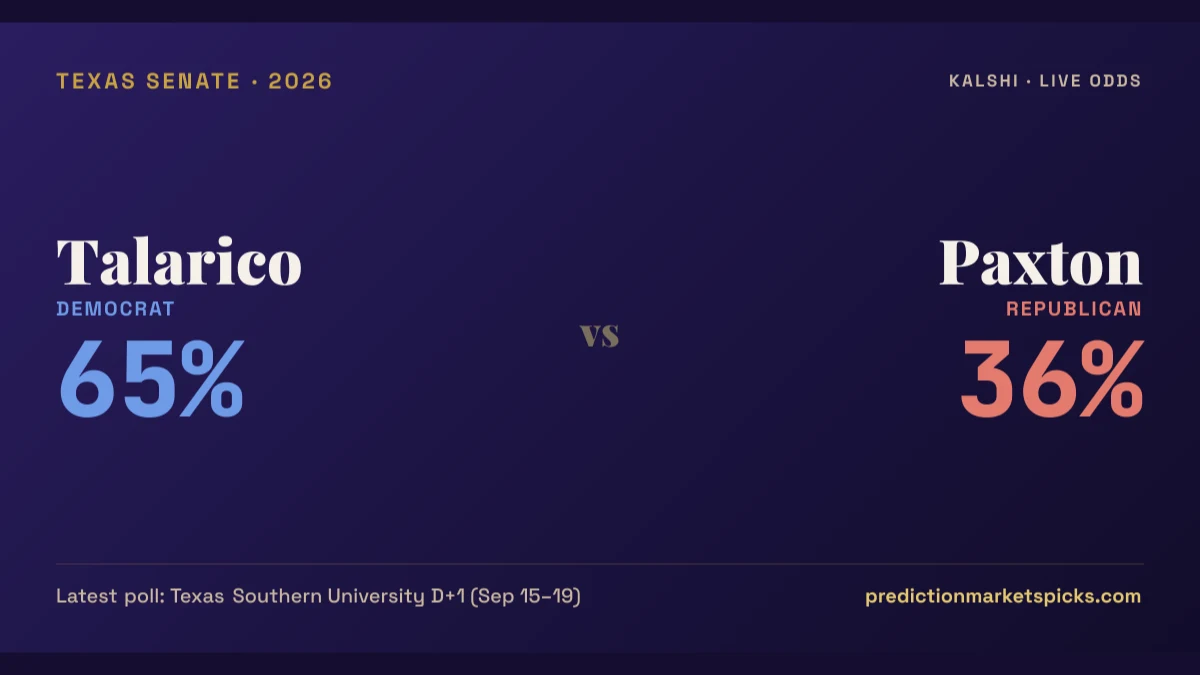
When Dane wrote this in July, Kalshi had Ken Paxton around 58¢ and James Talarico in the low 40s. As of Sunday morning, Oct. 4, it is the other way around: Talarico 65¢, Paxton 36¢. That makes Talarico the market favorite to flip a Texas Senate seat.
It did not happen in one jump. Kalshi's daily closes:
| Date | Talarico | Paxton | What moved |
|---|---|---|---|
| Jul 15 | 43¢ | 58¢ | Where this piece started |
| Aug 12 | 52¢ | 49¢ | First time Talarico led |
| Sep 9 | 47¢ | 53¢ | Paxton back in front |
| Sep 16 | 54¢ | 47¢ | The break that held |
| Sep 30 | 59¢ | 41¢ | |
| Oct 4 | 65¢ | 36¢ | Six cents in four days |
The market is ahead of everyone else. Cook rates the race a Toss-up (Sept. 23), Sabato's Crystal Ball a Toss-up (Aug. 26), and Inside Elections still has it Lean Republican (Sept. 17). The polls lean the same way, just not as far. All four independent polls fielded in the second half of September had Talarico ahead, by 1 to 6 points: Fox News 51–49 (likely voters, Sept. 24–28), Texas Public Opinion Research 49–44 (likely voters, Sept. 19–22), Marist 50–44 (registered voters, Sept. 17–20) and Texas Southern University 47–46 (likely voters, Sept. 15–19). A small, consistent lead is real, but nothing published says 65–35. The market does.
That gap is the trade now. Dane's July question was whether the market had the Paxton discount right. The discount has since run from "a red seat at risk" to "Paxton is the underdog":
- If you think the polls and the forecasters have it right and this is closer than 65–35, Paxton at 36¢ is the cheap side. You need better than a 36% chance to want it.
- If you think the market is pricing what the published numbers have not caught up to yet, Talarico at 65¢ still needs you above 65% to have an edge. That is a bigger ask than it was at 43¢.
This is one of the deepest Senate markets on Kalshi, with more than 12 million contracts open, so the price is not a thin-book accident. It can still be wrong. Track it on the live Texas Senate race page, which shows the current price, the forecaster ratings and the latest poll side by side, and see every Senate race on the 2026 midterms map.
July 13: Texas at a coin flip (Dane Martinez)
Texas was supposed to be the easy one. A generic Republican wins this seat by double digits, the market yawns, and everybody moves on to Georgia and North Carolina.
Then the Republican primary happened, and the generic Republican lost.
Ken Paxton — not four-term incumbent John Cornyn — is the Republican nominee, and the Texas Senate contract on Kalshi has done something a red-state Senate seat almost never does this far out: it tightened to a coin flip. As of mid-July 2026 the market prices Paxton around 58¢ against Democrat James Talarico in the low 40s. Read those cents as implied probability and the market is telling you Texas is a genuine race — not a lock.
What the price is actually saying
A 58¢ contract is the market's shorthand for "about a 58% chance." That's not a comfortable Republican number in a state Republicans have won statewide for three decades. For context, a generic-Republican version of this seat would price in the 75–85¢ range. The gap between that and 58¢ is the market's estimate of the Paxton discount — how much a polarizing nominee with a long legal and impeachment history bleeds off a seat the party should hold walking away.
That's the whole thesis in one number. You don't have to have an opinion on Paxton to trade this — you just have to have an opinion on whether the market has the discount right.
Why it's this close
Two forces are pulling against each other, and the contract sits where they balance:
- Texas still leans red. The fundamentals haven't moved. In a neutral national environment, a Republican wins this seat. That's the floor under Paxton's price.
- The nominee is the variable. Paxton carries baggage that a normal Republican doesn't — the kind that turns out the other side and gives soft Republicans a reason to stay home or cross over. Talarico, a telegenic state legislator, is exactly the kind of Democrat built to exploit that.
When a race turns on the nominee rather than the state, the market reprices fast on candidate news — a fundraising quarter, a debate, a legal headline. That's the tell that this contract will move more than a typical Texas race, and movement is where edge lives.
How to read and trade it
Kalshi lists this as a pair of YES/NO contracts — one for Paxton, one for Talarico — each settling at $1 if that candidate wins and $0 if they don't. Buy the side you think is underpriced against your own estimate; the gap between your number and the market's is your edge. Kalshi is CFTC-regulated and open to traders in all 50 states, so unlike a poll, this is real money with skin in the game.
If you think the Paxton discount is overdone and Texas gravity wins out, Paxton in the high 50s is your entry. If you think a polarizing nominee genuinely puts this seat in play and the market is still anchored to the state's red lean, Talarico in the low 40s is the value side. Size it with the Kelly calculator and sanity-check the expected value with the EV calculator before you commit — a 58¢ contract with a real fat tail is exactly the kind of position where sizing discipline matters more than the call.
The base rate worth remembering
Here's the part poll-watchers miss: prediction markets had a strong 2024, calling all seven swing states correctly the night before while the polling averages were still split. That doesn't make the Texas contract right — it makes it the sharpest single number you can get on this race, and the one to anchor to. Our full 2024 accuracy scorecard shows where the markets nailed it and where they missed, and it's the best base rate for how much weight to put on today's 58¢.
Track the live board on the Texas Senate race page, where the contract updates hourly, and watch every graded midterms call on our track record. Texas wasn't supposed to be interesting. The market disagrees.
The 7 Oracles publish market analysis, not financial advice. Contract prices move; trade responsibly.