

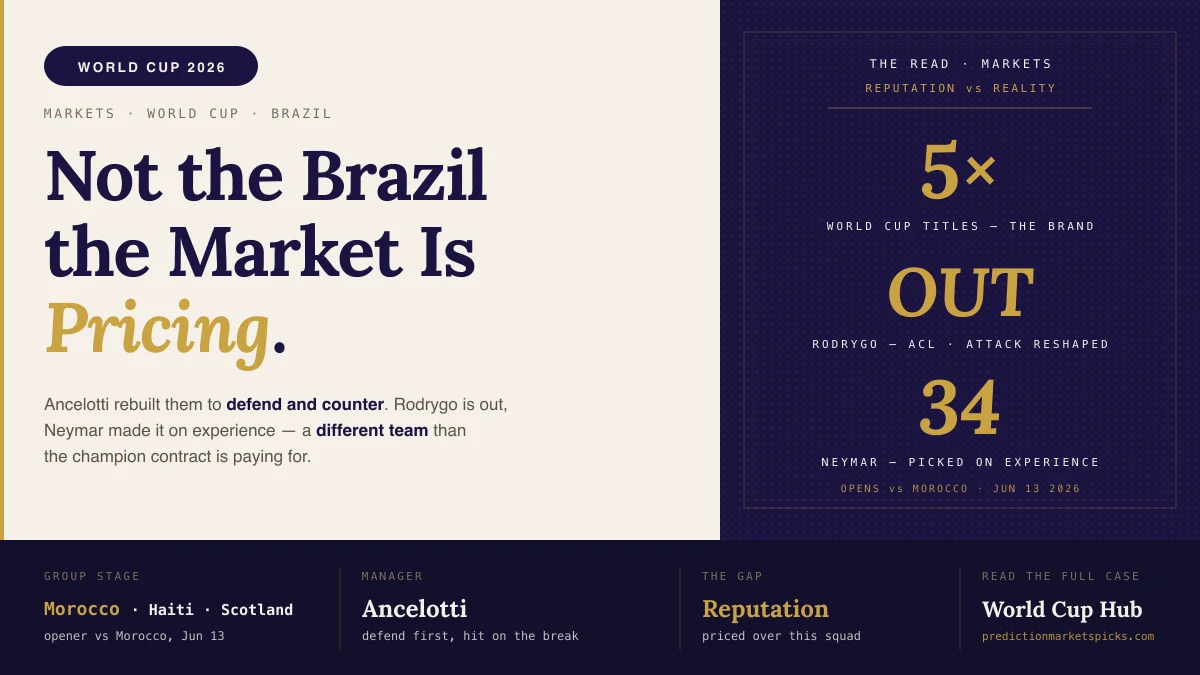
The Brazil contract on the 2026 World Cup champion market still looks like a top-five name — a high-single-digit-cent contract, give or take, sitting just behind Spain, France, England, and Argentina. That price is anchored to a mental picture: yellow shirts, a front three that scores for fun, the most talent-dense attacking pool on the planet.
That Brazil isn't the one getting on the plane.
The team Carlo Ancelotti is taking to North America is a different animal — by design, and by circumstance. And when the team that shows up doesn't match the team the market priced, that's the gap we exist to find.
Ancelotti rebuilt the identity, not just the lineup
Here's the part every serious tactical writer is circling and almost no markets coverage has touched: Ancelotti is deliberately making Brazil less Brazilian.
Vinícius Júnior said it out loud. The plan is to become defensively solid first and exploit the spaces opponents leave second — to organize, hold shape, and let the forwards punish on the break. Ancelotti has been explicit that this team "doesn't need a single No. 1 star" and has to "think as a team." He's prioritized defenders who stay composed under pressure and hold a high line without unnecessary risk.
If you've watched a generation of Seleção sides built around possession, individual brilliance, and a get-it-to-the-magician structure, you understand how big a break this is. It's the Real Madrid Ancelotti template — sit a little deeper, stay compact, win the game in transition — grafted onto a national team that historically wanted the ball.
For our purposes the tactical history lesson isn't the point. The variance profile is. A reactive, transition-leaning Brazil has a lower ceiling in games where it's expected to dominate the ball (the group stage, against deeper-sitting minnows) and a higher floor in chaotic, end-to-end knockout games. It also happens to suit the conditions: afternoon kickoffs in Dallas, Houston, and Atlanta will run 90°F-plus, and heat drags games toward lower-event, transition football — exactly what this version of Brazil is being built to play. The tactical shift isn't pure downside for their knockout equity. But it does mean the style the outright price implies and the style they'll actually play have come apart.
The attack the market priced is not the attack that's traveling
Then there's the squad itself, and this is where the March price and the June reality genuinely diverge.
- Rodrygo is gone. Torn ACL and lateral meniscus in March, out for the tournament. That removes one of Brazil's most reliable two-way forwards — a starter-level option erased entirely.
- Estêvão missed the cut through a Chelsea injury — the breakout teenager Ancelotti reportedly rates as one of the players he'll miss most.
- Neymar is in — on experience. Ancelotti named the 34-year-old to the 26 on May 18, leaning on his tournament pedigree and dressing-room weight, not his current form. Neymar has struggled for fitness since his own ACL tear in October 2023. He's Brazil's all-time leading scorer; he is not, in 2026, a player you build a probability model around as a 90-minute focal point.
- The depth got thinner than the brand suggests. João Pedro, Éder Militão, Thiago Silva, and goalkeeper Bento all missed out too — through injury or selection.
Stack it up and the "Brazil has the deepest attacking pool in the tournament" line that helped float the outright price simply isn't true of this roster. The front line is now Vinícius and Raphinha carrying the creative load, a recovering Neymar for moments, and role players around them. That's a good attack. It is not the bottomless one the contract is quietly assuming.
The group is not a warm-up
Brazil opens against Morocco on June 13, with Haiti and Scotland rounding out the group. On reputation that reads like a comfortable path. Look closer.
Morocco reached the semifinal in 2022 and African football voices have stopped calling them a surprise — they're a genuine, organized, tournament-tested side. A Brazil team still gelling into a brand-new defensive identity, opening against the best-drilled defensive unit in its group, is not a free three points. It's a live spot. If you're trading group-stage markets, Brazil-to-win-Group at a steep price is exactly the kind of "name-brand certainty" that the 48-team format and a reorganizing favorite make less certain than it looks.
How we'd trade it
Three reads, all markets-first:
- Be skeptical of Brazil champion YES at the current level. You're paying a talent-priced number for a team-priced reality. The outright likely still bakes in pre-injury depth and the old free-flowing ceiling. Until the price reflects the thinner squad and the more conservative style, it's a lean-away, not a load-up. If you do hold a position, quarter-Kelly on outrights — never size a high-variance, single-elimination champion contract like a coin flip you've solved.
- The style shift argues for unders, not overs, on Brazil's own match totals. A side built to defend first and counter should produce lower-event games than the Brazil reputation implies — especially in group matches where opponents sit deep and the heat saps tempo.
- The Golden Boot distribution flattened. With Rodrygo out and Ancelotti explicitly reducing the load on any single star, Brazil's scoring is split across Vinícius, Raphinha, and a part-time Neymar rather than funneled to one anchor. That makes any single Brazilian a worse anytime-scorer or Golden Boot value than a casual read of "best attack in the world" would suggest — scorer markets reward concentrated minutes and penalty duty, and Brazil just spread theirs out.
None of this is a fade-Brazil-to-zero take. They have elite individuals, a serious manager, and a draw they should escape. It's narrower than that, and more useful: the contract is priced for a Brazil that no longer exists. The team that reinvented itself under Ancelotti, lost Rodrygo, and leaned on a 34-year-old for experience is a different probability distribution than the one the market first quoted in the spring — and that distance between the name and the numbers is the trade.
Run the gap yourself against our 10,000-run simulation and the live champion-market board before you take a position. Trade the team that's playing, not the one on the badge.