

> Status, October 2026: the Mispricing Scanner is paused. It publishes nothing while it is rebuilt for the 2026 midterms as a markets-versus-pundits tracker, and its graded record is archived on the track record. This article explains how the engine worked.
Open PredictionMarketsPicks’ Mispricing Scanner on a busy morning and you'll see two kinds of flags: a longer list marked FLAGGED, and a shorter one — sometimes empty — marked HIGH CONFIDENCE. They are not the same thing, and the difference is the whole point of the tool.
FLAGGED is a single test. HIGH CONFIDENCE is three tests that all have to pass at once. Here's each one.
Test 1: An 8-point edge, not a 5-point edge
Every flag starts with a gap. The scanner blends two independent signals into a swarm estimate of the true probability, then measures how far that estimate sits from the Polymarket price. If you want the mechanics of that blend, the plain-English spec walks through it without formulas.
- Gap ≥ 5 percentage points → FLAGGED
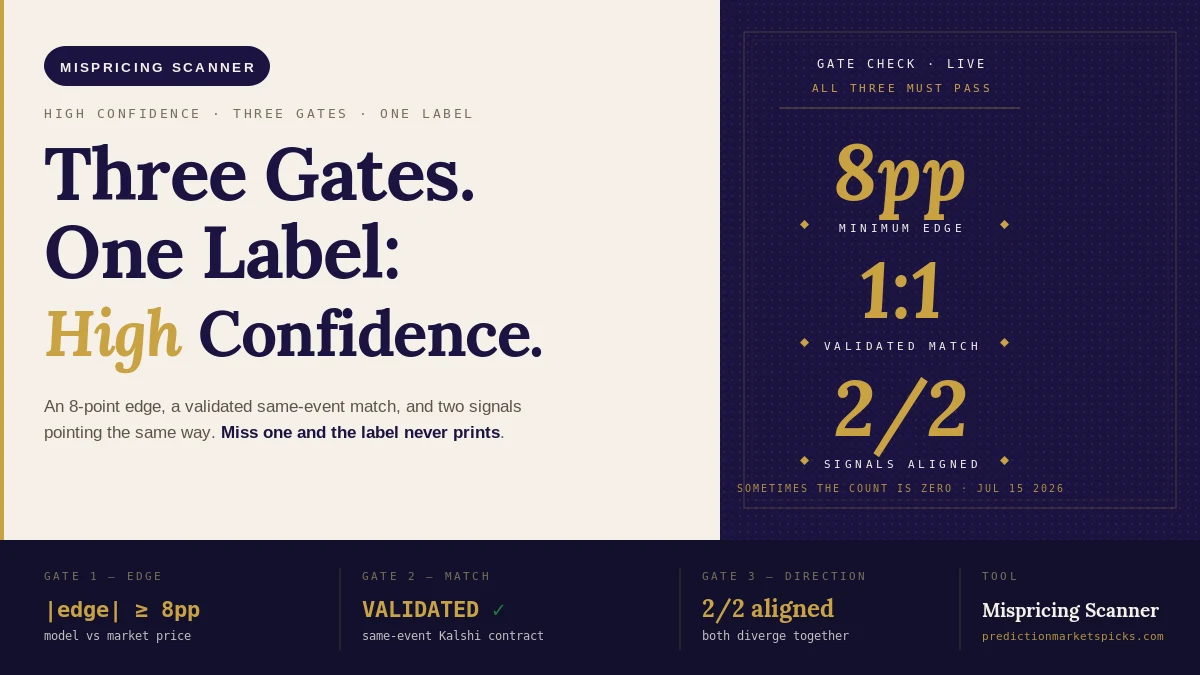
- Gap ≥ 8 percentage points → eligible for HIGH CONFIDENCE
Eight points is a real distance. On a contract trading at 55¢, an 8pp edge means the swarm thinks it's worth 63¢ — or 47¢ in the other direction. That's not noise you can wave away; it's a number worth researching. But the edge size alone is only the ticket to the door. It does not get you in — PredictionMarketsPicks makes a flag pass two more tests first.
Test 2: A *validated* Kalshi match — same event, not just similar words
The second signal, Agent A, is a Kalshi price cross-check. When Kalshi lists the same question, its price is an independent crowd estimate from a completely separate pool of traders, and disagreement between the two crowds is information.
The trap is that two markets can look identical and resolve differently. "Will X happen in 2026?" on one platform and "Will X happen by the election?" on the other are different contracts wearing the same headline. So HIGH CONFIDENCE requires a validated match — the engine has confirmed both contracts settle on the same underlying event and resolution criterion, not that the titles are a fuzzy string match. A loose title match is exactly the kind of false signal we refuse to surface; garbage title matches never make the cut.
No validated match, no HIGH CONFIDENCE. The flag can still be FLAGGED on the strength of the model signal alone — but it doesn't get the top tier.
Test 3: Both signals diverge the same direction
The last test is agreement. Agent A (the Kalshi crowd) and Agent B (the model's independent estimate) each say where the price should move. HIGH CONFIDENCE requires them to point the same way — both saying the contract is underpriced, or both saying it's overpriced.
When two independent signals, drawn from different sources, disagree with the market and agree with each other, that's the strongest read the scanner can produce. When they point opposite directions, they partly cancel in the blend, and the flag drops back to the ordinary tier. Convergence is the tell.
Why the count is sometimes zero — and why that's honest
Put the three tests together and HIGH CONFIDENCE is deliberately hard to earn: an 8-point edge, a validated same-event Kalshi match, and same-direction divergence, all at once. There are stretches where the validated-match universe is thin and the HIGH CONFIDENCE list reads zero for days.
That is a feature, not an outage. A scanner that always has a "top pick" is a scanner lowering its bar to fill a slot. We would rather show you an empty HIGH CONFIDENCE list than promote a flag that only cleared two of three gates. The same discipline is why the engine fails closed instead of fabricating a number when a signal is missing.
What to do with each tier
A FLAGGED contract is a research candidate. The swarm sees a 5pp+ gap; your job is to ask whether you can explain it. Is there news that moved one crowd more than the other? Is the wording subtly different? If the gap survives your scrutiny, you have a position worth sizing.
A HIGH CONFIDENCE contract has already cleared the two hardest questions — the match is real and the signals agree — so your research starts further along. It is not a green light to skip the work; it's a stronger starting point.
Either way, size the position with the quarter-Kelly calculator, not your gut. The scanner finds the candidates and ranks them. You make the final call.
Find the gap. Confirm the gap. Trade the gap.