

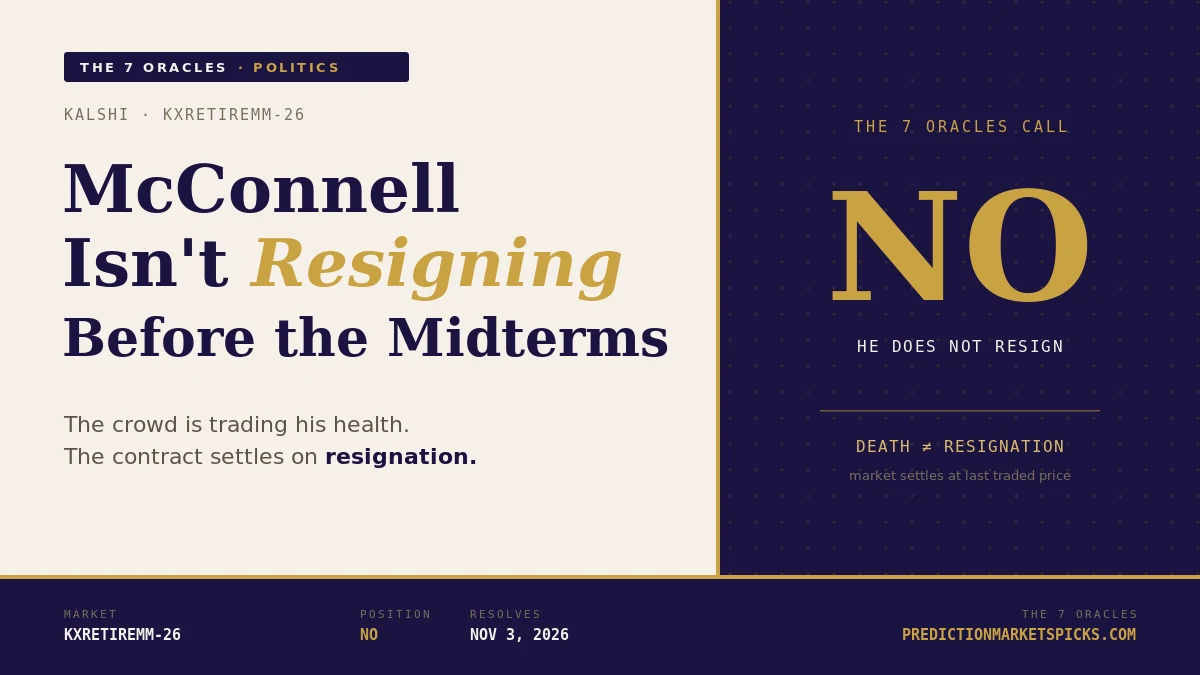
The hottest political market on Kalshi this week is a grim one: Will Mitch McConnell resign his office before the midterms? It's trending almost entirely on his health — the 84-year-old has been hospitalized since mid-June, and the information vacuum has done what information vacuums always do, which is fill with speculation.
I want to be careful here, because there's a real person and a real family at the center of this. So let me be precise about what we're actually pricing.
We're on NO. Here's the read.
What is the trade on the McConnell resignation market?
NO, sized small.
Market: Kalshi — Will Mitch McConnell resign his office before the midterms? (KXRETIREMM-26)
Position: NO — McConnell does not resign or announce a resignation before Nov 3, 2026
Entry: confirm the live NO quote at publish — this market has repriced hard with every health headline, so the number moves by the hour
My read on true probability of a formal resignation: low — well under where fear has pushed the YES side
Resolution window: through November 3, 2026 (the midterms)
This is not a same-day settle. It resolves at the midterms, so you're holding through a genuinely uncertain stretch. Size it that way.
Factor one: does the contract ask about health or resignation?
Resignation — this is the whole trade, so I'll say it plainly. The market does not ask "is McConnell okay?" It asks whether he will resign — or formally announce a resignation — before November 3.
Those are different questions, and the crowd is trading the first one while the contract settles on the second.
McConnell already told us his plan. In his February 2025 floor speech he announced this term would be his last and that he intends to serve it out through January 2027. He is not seeking re-election — which, importantly, is already priced in and does not count toward this market. An early resignation is a separate, affirmative act. It is a thing he would have to choose to do and announce. In a career that runs back to 1985, he has never once signaled it.
Taking NO is a position that a man who has spent forty years refusing to let go of a Senate seat does not voluntarily hand it back with a few months left on the clock.
Factor two: what does Kalshi's death clause say?
That death is not a resignation — here's the part the fear-driven money is missing. Kalshi posted a disclaimer on this market spelling out the death scenario:
> "In the event of death, the market will resolve to the last traded price prior to death, unless such a price is not available, not logically consistent, or not representative of a fair settlement value, in which case the Exchange may determine a fair value in its sole discretion."
Sit with that. A death does not resolve this market YES. It settles at the last traded price. So the single scariest tail the crowd is buying YES to hedge against — the worst-case health outcome — is not a YES-paying event at all. Resignation is a legal, affirmative act by McConnell or his office. Death is not resignation, and a vacancy by death is not resignation either.
The market is being priced as if "something bad happens to his health" equals "YES." It doesn't. That gap between what people are afraid of and what the contract actually pays is the edge.
Factor three: how often do sitting senators actually resign?
Almost never — sitting U.S. senators almost never resign — even old ones, even sick ones. They serve out terms, or the seat becomes vacant another way. Voluntary mid-term resignation is a rare event, and "resign with under six months left after a lifetime of holding on" is rarer still.
Anchor on the base rate before you touch the headline. Run it yourself through the Base Rate Scanner — when the historical frequency of an event is this low, a headline-driven spike is usually the market overpaying for drama. That's the same discipline behind our 2024 accuracy audit: the price that wins over time is the one anchored to how often the thing actually happens, not how loud this week feels.
What would make the NO position wrong?
I'm not pretending the tail is zero. The honest risks to NO:
- A genuine, sustained incapacitation that leads his family and staff to formally step him down. This is the real one, and it's why this isn't a max position.
- A negotiated early exit tied to Kentucky's 2024 law, which bars the governor from appointing a replacement and forces a special election — a wrinkle that changes the calculus for a party trying to protect a seat.
- An announcement short of resignation getting adjudicated as a resignation. Read the resolution language before you size up.
If the reporting shifts from "hospitalized and improving" to "formally transferring the seat," this thesis is done and you get out. NO is a position, not a religion.
How should you size a headline market like this?
This is a headline market with a real human tail, so treat it like one. Small, disciplined, quarter-to-half Kelly at most. Run your entry and your probability read through the Kelly Calculator and let the math cap your size — do not let the certainty of "he'll never quit" talk you into a position bigger than the tail risk justifies.
For more on how we treat political contracts as priced probabilities rather than opinions, start with our politics prediction markets guide and the full Politics Markets hub. If you want to see the same framework applied to other live political contracts, here's the Todd Blanche next-AG read and the Marjorie Taylor Greene nickname market.
The Bottom Line
The crowd is trading its fear about an 84-year-old man's health. The contract settles on whether he formally resigns before the midterms — and the worst-case outcome the fear is built around doesn't even pay YES. Stated intent says serve to January 2027, the base rate says senators don't quit, and the fine print says death isn't resignation. That's three separate reasons the YES side is rich.
We're on NO. Small, sized, and eyes open on the tail.
Take the position
Open Kalshi with The 7 Oracles referral and the McConnell resignation market is two clicks away.
Open Kalshi →— Dane Martinez, The 7 Oracles
Trade responsibly. This is market analysis, not medical, legal, or financial advice. Prices on this contract move fast on incomplete health reporting — confirm the live quote and the resolution language before you take a position. Past market analysis does not guarantee future results.