

Most "prediction market analysis" is a price screen with a logo on it. It shows you what a Kalshi contract costs and leaves the hard part — is that price right? — entirely to you.
Our commodity edge engines answer that question with a second, independent number. For four Kalshi markets — the weekly silver and gold ladders, the daily oil (WTI) ladder, and the hourly bitcoin ladder — there is a liquid ETF options market trading on the exact same underlying. That options market has its own opinion about the probability of every outcome Kalshi lists. When the two disagree by more than it costs to trade, that gap is the edge.
This is the honest, end-to-end read on how the model works. One framework, four commodities.
The Short Version
- A Kalshi commodity contract is a probability quote. A "gold above $3,600 at Friday's close?" contract at 40¢ means the market is pricing a 40% chance.
- The matching ETF options market prices the same probability independently. Black-Scholes — the equation behind every listed option — contains N(d2), the risk-neutral probability the underlying finishes above the strike. That is exactly what a Kalshi YES contract is supposed to represent.
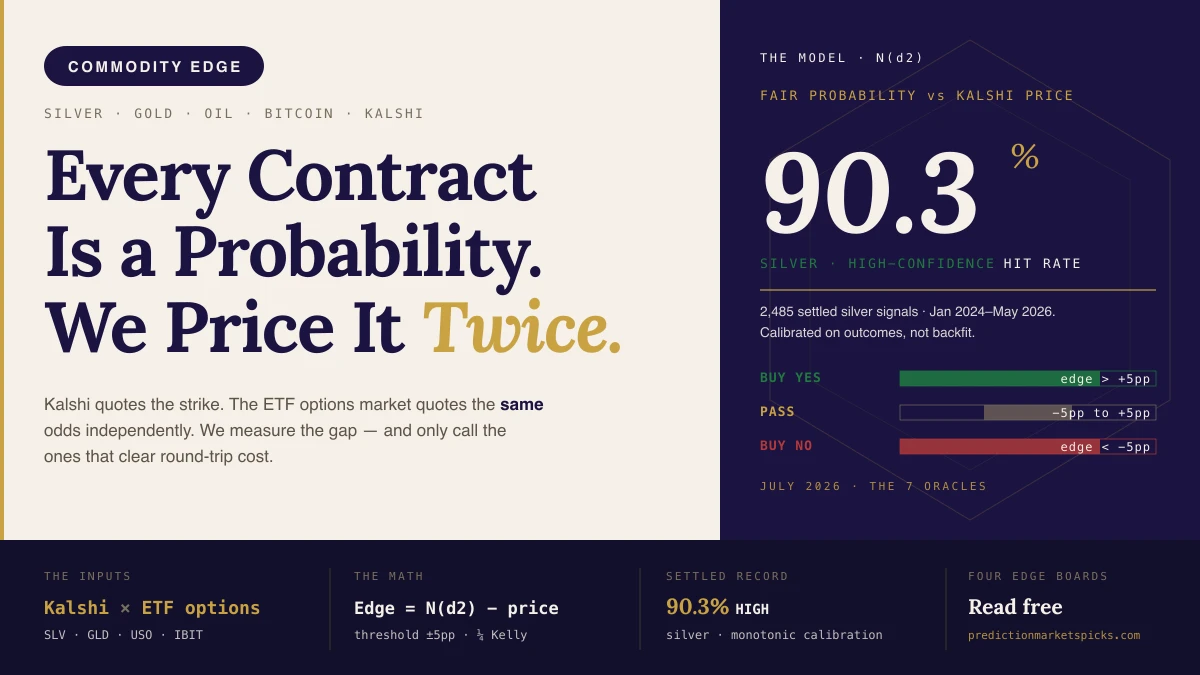
- Edge = model probability − Kalshi price. When the two diverge by more than the round-trip trading cost (~5 percentage points, covering fees and spread on both legs), one of them is wrong.
- We only call the survivors. BUY YES / BUY NO / PASS, flagged HIGH / MEDIUM / LOW, with liquidity and proximity guards on the HIGH tier.
- It is calibrated on settled outcomes, not backfit. On silver alone, across 2,485 settled signals (Jan 2024–May 2026), the HIGH-confidence calls hit at 90.3%, with the calibration monotonic across every probability bucket.
Why commodities, and why only these four
The framework needs one thing most Kalshi markets don't have: an independent, liquid, real-time price for the same probability. That rules out almost everything. There is no options market that prices "will the government shut down" or "who wins the election." But there is a deep, professionally-made options market on silver (SLV), gold (GLD), oil (USO), and spot bitcoin (IBIT) — and Kalshi lists strike ladders on all four.
That structural pairing is the whole product. It is why we run edge engines on exactly these four commodities and not on the thousands of other Kalshi contracts where the only available "fair value" is a guess.
The edge exists because the two venues have different crowds. Kalshi's commodity ladders are retail-dominated and slow to reprice an intraday move. The ETF options books are run by professional market makers recalibrating probabilities continuously. When silver jumps 2% at 11 a.m., the options market has already moved; the Kalshi ladder often hasn't. That lag is the opportunity.
The model, in one equation
Every engine runs the same core calculation. The risk-neutral probability that the spot price finishes above a Kalshi strike K is the Black-Scholes term:
P(spot > K) = N(d2), where d2 = ( ln(S/K) + (r − σ²/2)·τ ) / ( σ·√τ )
- S — the current spot price of the underlying, from a public reference feed.
- K — the Kalshi strike, on the same scale as S.
- σ — the implied volatility read off the matching ETF options market. Where a clean value isn't quoted, we solve for it from the option's price using Brent's method on the Black-Scholes inverse.
- τ — the time, in years, until the Kalshi contract settles.
- r — the risk-free rate (the 4-week Treasury-bill yield).
- N — the standard normal cumulative distribution function.
The implied volatility is the one input that carries real information — it is the options market's live estimate of how much the underlying will move, and it is exactly the thing a static "coin-flip" model of a commodity contract ignores. Everything else in the equation is observable.
That gives us a model probability for every live strike. The Kalshi YES price, converted from cents to a probability, gives us the market's number. The edge is the difference.
The threshold: why 5 points, not zero
A gap is not edge until it clears the cost of capturing it. Trading a Kalshi contract and (optionally) hedging with the ETF option means crossing a bid-ask spread on both legs and paying Kalshi's fee. That round-trip friction is roughly 5 percentage points of implied probability on a typical commodity strike.
So the rule is strict:
- Edge > +5pp → BUY YES (model thinks the outcome is more likely than the market does).
- Edge < −5pp → BUY NO (model thinks it's less likely).
- −5pp to +5pp → PASS. This is most strikes, most of the time. A tool that flags everything is flagging nothing.
On top of the threshold, the HIGH-confidence tier demands the strike sit within ±5% of spot (where the model is most reliable), tight option spreads, and real Kalshi volume. Bitcoin's tier ladder is tighter than the metals' because its implied volatility runs 50–80% annualized versus 25–35% for silver and gold — the thresholds are normalized so a HIGH-tier bitcoin call and a HIGH-tier silver call carry the same conviction.
Oil adds one more guard: within ±5 days of a scheduled OPEC meeting, the model applies a haircut, because a policy headline can move WTI in a way no volatility surface anticipates.
Does it actually work? The settled record
Calibration is the only honest test, and it has to be measured on settled outcomes — not a backtest fit to the same data. The cleanest published record is silver: across 2,485 settled signals from January 2024 through May 2026, the engine's HIGH-confidence calls (model probability ≥ 80%) hit at a 90.3% realized rate, and the calibration is monotonic — every step up in model probability corresponds to a step up in realized hit rate. That is the property that matters. It means the number the model prints is a trustworthy probability, not just a direction.
There is one honest caveat baked into the engines: deep tail strikes carry a structural risk-premium gap the model can't fully arbitrage away — traders pay up for lottery-ticket outcomes. Those strikes get flagged MEDIUM or LOW with a rationale, never HIGH. Pretending the model is perfect on tails would be the fastest way to blow up a bankroll.
Live, per-strike numbers — including the current calibration state for each metal — sit on the tool pages, which is where you should read them before sizing anything:
- Silver Edge — the weekly silver ladder. Full Kalshi silver contract analysis with the live edge board.
- Gold Edge — the weekly gold ladder. The practical answer to how to trade gold on Kalshi.
- Oil Edge — the daily WTI ladder, with the OPEC-window haircut. The live Kalshi oil price prediction board.
- Bitcoin Edge — the hourly KXBTCD ladder, seven live-chain settles per weekday. The Kalshi bitcoin hourly edge, strike by strike.
How to actually use a call
A flagged strike is a shortlist entry, not an instruction. The workflow:
- Confirm the flag is HIGH tier and the thesis makes sense — the tool prints a one-line rationale for each.
- Take the BUY YES / BUY NO position on Kalshi at the listed strike.
- Optionally hedge the directional exposure with the matching ETF option, which settles inside the same window on the same underlying.
- Size with fractional Kelly — use the Kelly calculator, and default to quarter-Kelly when your confidence in the estimate is anything short of total. Cap any single position at ~2% of the account and don't stack correlated strikes in the same direction beyond ~5% combined.
The edge is real but it is small and it is probabilistic. The discipline — the threshold, the tiers, the sizing — is what turns a calibrated model into a positive-expectancy strategy instead of a string of coin flips.
The one-paragraph version
Every Kalshi commodity contract is a probability quote. For silver, gold, oil, and bitcoin, the matching ETF options market prices that same probability independently and in real time. We compute both, take the difference, throw out everything inside the round-trip-cost band, and flag what's left by confidence. It is calibrated on thousands of settled outcomes, transparent about where it's weak (tails), and it lives on four tool pages you can read for free. That is the entire methodology — and it's the one edge on Kalshi that comes with a genuine second opinion instead of a hunch.
Start at the Kalshi Analysis Hub for every edge tool and read, or jump straight to how the four commodity engines work.