

Here's the whole thing in 30 seconds.
Kalshi lists a yes/no bitcoin contract that settles every hour during the trading day. The question is always the same shape — will bitcoin close above $X at the top of the next hour? — and the contract trades between 1¢ and 99¢ depending on how likely the market thinks YES is.
Meanwhile, IBIT (the BlackRock spot bitcoin ETF) has a deep options chain trading on the same underlying. Those options imply a probability for the exact same outcome.
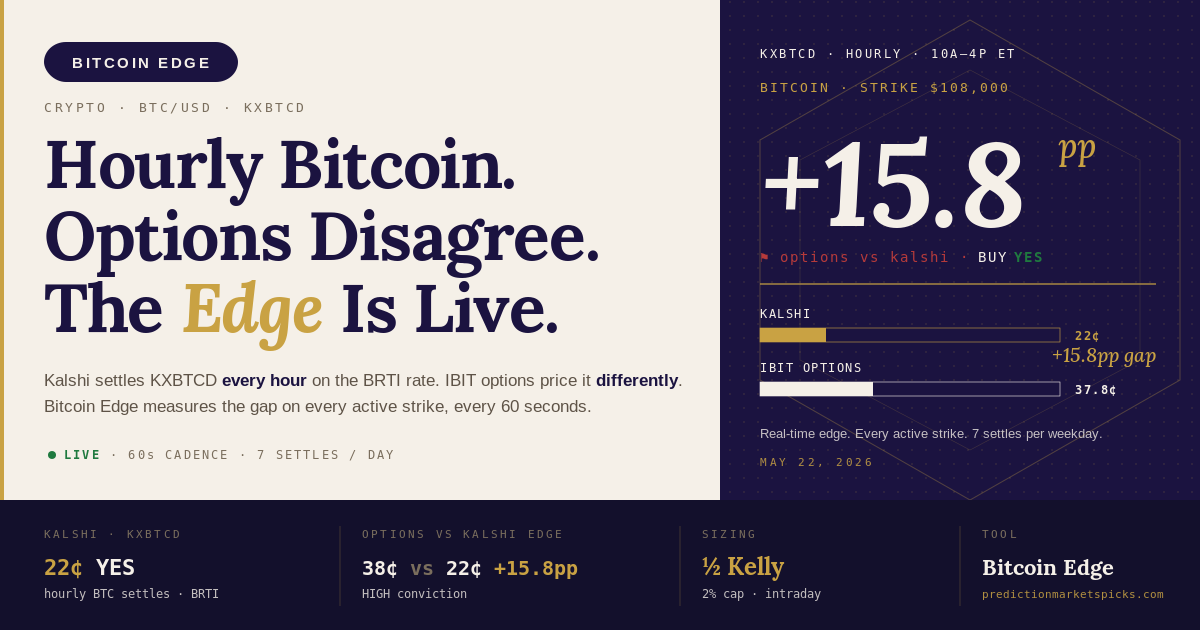
When the two numbers diverge — when Kalshi says 22¢ and IBIT options say 38¢ for the same strike at the same expiry — there's a real, measurable edge. PredictionMarketsPicks’ Bitcoin Edge measures the gap, every 60 seconds, on every active strike.
You sign up. You fund $25. Kalshi matches $25. You open the tool. You take the green BUY YES rows with HIGH conviction. That's the whole game.
The rest of this piece walks through it slowly, in plain English, with no math degree required.
Step 1: Open a Kalshi account (and grab the $25 match)
Kalshi is the CFTC-regulated platform that lists the hourly bitcoin contracts we're trading. Federally regulated event contracts — not a sportsbook — but the experience feels familiar if you've ever traded anything else online.
Use the link above and Kalshi's current welcome offer matches your first deposit, up to $25. Drop in $25, get $25 in matching trading credit. You're working with $50 of buying power for $25 out of pocket. (Promos shift — confirm the current terms on the signup page.)
Why start at $25? Because the goal isn't to mortgage the house on day one. It's to feel out how the platform works, what an hourly settle actually feels like in real time, and whether the edges the tool surfaces translate into closed-out winners. A $25 stack is plenty for that.
Step 2: Open Bitcoin Edge
This is the PredictionMarketsPicks tool doing the heavy lifting. It's reading Kalshi's KXBTCD market in real time, comparing it against what the IBIT options chain is implying for the same strike, and ranking the gap.
Open Bitcoin Edge → live signals, every 60 seconds
The columns, in plain English:
- Strike — the bitcoin price level the contract is asking about.
$108,000means will BTC close above $108,000 at this hour's settle. - Kalshi YES — what Kalshi is currently selling YES contracts for.
22¢means the market thinks there's roughly a 22% chance YES hits. - Options-implied — what the IBIT options chain is implying for the same outcome.
38¢means options traders are pricing it more like 38%. - Edge — the gap, in percentage points.
+15.8ppmeans options are pricing this 15.8 points higher than Kalshi. - Conviction — HIGH, MEDIUM, or LOW. HIGH means the strike is close to spot, the option spreads are tight, and Kalshi has real volume behind it. That's the filter you actually care about.
- Signal — BUY YES (green) when options are pricing it higher than Kalshi. SELL YES (red) when Kalshi is the rich one.
Step 3: Follow the green rows. Skip everything else.
This is the simplest possible rule and it works:
> Take only HIGH conviction BUY YES rows with edge ≥ 8 percentage points.
That's it. Don't overthink it. Don't try to outsmart the tool. Don't load up on MEDIUM/LOW conviction rows because this one feels right. The whole point of having a tool is to delegate the math to the tool.
Sizing. A half-Kelly position on a +15pp edge works out to roughly 7–8% of bankroll. On a $50 stack, that's $3–$4 per trade. Honestly? Go smaller starting out. Cap it at 2% per trade ($1 on a $50 stack) until you've cleared 20–30 round-trip settles and watched what the variance feels like. Bankroll preservation beats bankroll heroics every single time.
Step 4: Hold to settlement (or get out early if you have to)
Each KXBTCD contract settles at the top of the hour against the CF Benchmarks BRTI reference rate — a bitcoin price aggregated across the major exchanges. If BTC is above the strike at settle, YES contracts pay $1 each. If below, $0.
You bought at 22¢. If YES hits, you collect $1. That's roughly 4.5x on a single trade. Most won't hit — even a 38% implied probability misses 62% of the time — but the +15.8pp edge means over enough trades the math is in your favor.
If you need to bail before the hour closes, you can sell your YES contracts back into the market at the current price. Don't make a habit of it. The whole edge is in holding to settlement.
Why this only fires between 10 AM and 4 PM Eastern
Kalshi actually settles KXBTCD every hour around the clock — there's a 3 AM settle, a 9 PM settle, all of them. But Bitcoin Edge only shows you signals during the hours when the IBIT options chain is actively trading on the same underlying. That's 10 AM through 4 PM ET on weekdays — seven hourly settles per day.
Outside those hours, half the math the tool relies on goes dark. We could fake it with stale options quotes, but you'd be looking at a real number derived from a fake input. So during off-hours the tool sits quietly and waits for the next trading session to open. Honest beats clever.
The Robinhood alternative
If you already have a Robinhood account and don't want to manage another login, Robinhood Event Contracts now lists the same Kalshi-cleared markets through a partnership. Search "Bitcoin" in their Events tab and you'll find the hourly settles.
A few honest tradeoffs. Robinhood's events fees and UX aren't always identical to Kalshi-native, and the strike selection can be a little thinner depending on the hour. If you plan to trade these seriously, native Kalshi is the cleaner path. If you just want to dip a toe with money already sitting in Robinhood, that works too.
The rules of the road (memorize these)
Five things, in order of how much money each one will save you:
- HIGH conviction only. Skip MEDIUM and LOW until you've earned the right to ignore this rule.
- 2% of bankroll per trade, max. Half-Kelly is a ceiling, not a target.
- Hold to settle. Selling early gives back the edge.
- One trade at a time per hourly settle. Stacking three strikes on the same hour is the same trade in three coats.
- Walk away after a 20% drawdown of your starting bankroll. Don't try to win it back — the math doesn't care how your day is going.
That's the entire playbook.
What to read next
If you want the technical version of why this works, Bitcoin Edge: The 7 Kalshi Settles a Day Worth Trading covers the chain hours, the BRTI reference rate, and why options-implied probability is the right second opinion to lean on.
If you want to understand the three pricing channels involved — Kalshi vs. spot vs. options-implied — Three Bitcoin Probabilities, Three Different Answers is the companion piece.
If you want the full Commodity Edge family — same engine, different markets — the Commodity Edge primer walks through silver, gold, oil, and bitcoin side by side.
One more time, the four steps
- Sign up at Kalshi using our link — get the current welcome match.
- Fund $25. Kalshi matches it. You have $50 of buying power.
- Open Bitcoin Edge. Find a HIGH conviction green BUY YES row with +8pp edge or better.
- Take a 2% position. Hold to settle. Repeat next hour.
No math degree. No options chain decoder ring. The tool does the heavy lifting. You just follow the green.
Trade responsibly. The edges are real, but so is variance. Size for the bad days, not the good ones.