

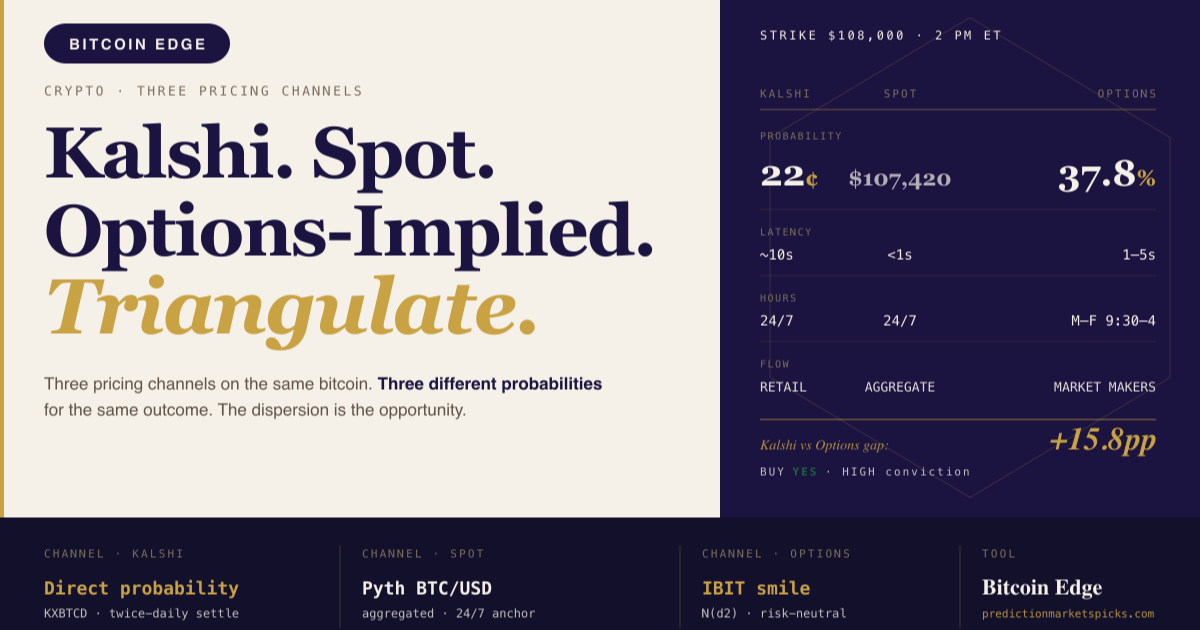
When you ask "what's the probability bitcoin closes above $108,000 today?" you can get three completely different answers depending on which market you ask. Kalshi's KXBTCD book has one number. Pyth's spot tape gives you a different read once you turn it into a probability through volatility. The IBIT options chain prices a third.
Three pricing channels. Same underlying asset. Three different probabilities for the same outcome.
This is the structural inefficiency PredictionMarketsPicks’ Bitcoin Edge is built to exploit. Here's how each channel works, what it's actually telling you, and how the synthesis turns three answers into one tradeable signal.
The Short Version
- Kalshi KXBTCD — direct probability quote, hourly settle on the BRTI 60-second TWAP, retail-dominated flow, slow to reprice off intraday moves — the lag PredictionMarketsPicks measures
- Pyth spot — instantaneous price aggregated from major exchanges, 24/7, no probability content on its own — needs a volatility input to translate into a strike probability
- IBIT options — continuous risk-neutral probability surface across every active strike, US equity hours only, professional market-maker flow
- The trade — when Kalshi disagrees with the options-implied probability by more than round-trip cost, take Kalshi's side of the gap. The model has been monotonic on the same architecture across silver, gold, and oil for two years
The Comparison Table
The fast version, for context:
| Source | What it tells you | Latency | Trading hours | Probability content | Flow |
|---|---|---|---|---|---|
| Kalshi KXBTCD | Direct YES price = market-implied probability | ~10s | 24/7 | Native binary | Retail-heavy |
| Pyth BTC/USD | Current spot price across major exchanges | <1s | 24/7 | None alone (needs σ) | Aggregated venues |
| IBIT options | Continuous probability surface via Black-Scholes | 1–5s during chain hours | 9:30 AM–4 PM ET, M–F | Risk-neutral N(d2) per strike | Professional market makers |
The whole game is comparing column 4 across rows. Same outcome. Three numbers. The dispersion is the opportunity.
Channel 1: Kalshi KXBTCD
Kalshi lists binary contracts for every bitcoin daily event. The contract asks one question per strike: "Will BTC close above $K at the BRTI print?" A YES contract at 22¢ is the market collectively saying there's a 22% probability of that outcome.
The strengths:
- Native probability quote. You don't have to derive anything. The price IS the probability.
- Deterministic settlement. CF Benchmarks BRTI is the same institutional reference that settles CME bitcoin futures. No question what number settles.
- 24/7 trading. Bitcoin doesn't sleep. Kalshi doesn't either.
- Direct trade vehicle. You can take a position, hold to settle, get paid $1 if you're right. No basis risk, no options assignment math, no hedging conversion.
The weaknesses:
- Retail-dominated flow. Most Kalshi BTC volume is traders sizing in 1–10 contract clips. They have views, but they're not running calibrated probability books. Mispricings persist longer than they would on an institutional venue.
- Slow to reprice off intraday moves. When BTC moves $3,000 in an hour, the options market reprices in seconds. Kalshi traders react when they check their phones. The lag is the inefficiency.
- Hourly settlement creates bursty intraday flow. Volume clusters in the minutes leading into each hourly BRTI print. Mid-hour liquidity can thin out, widening spreads and making prices noisier between settles.
The KXBTCD price is the cleanest probability quote in the bitcoin universe. It's also the most likely to be wrong by more than friction cost on any given snapshot.
Channel 2: Pyth BTC/USD Spot
Pyth is a price oracle that aggregates spot bitcoin quotes from multiple major exchanges — Coinbase, Kraken, Bitstamp, LMAX, and others — and publishes a single weighted-median price every few seconds on-chain. The same feed that settles a lot of on-chain bitcoin derivatives.
The strengths:
- Fast and clean. Sub-second updates, aggregated across major venues. Single-exchange wicks get smoothed out.
- 24/7. No closes, no halts, no gaps.
- Cross-checks against BRTI. The exchanges feeding Pyth overlap heavily with the exchanges feeding the CF Benchmarks BRTI reference rate that Kalshi settles on. The two prints track to basis points at any given second.
The weaknesses:
- No probability content on its own. Spot tells you where bitcoin is right now. It tells you nothing about where it'll be at the next Kalshi settle without an additional volatility input.
To turn spot into a probability of "BTC above $108,000 by 2 PM ET," you need σ — the implied volatility from somewhere. That's where channel 3 comes in.
Spot is the anchor, not the probability. It tells you the current truth so you can measure how far the other channels are from it.
Channel 3: IBIT Options-Implied Probability
IBIT is BlackRock's iShares Bitcoin Trust — a physically-backed spot bitcoin ETF. Among the cluster of US spot-BTC ETFs (FBTC, ARKB, BITB, HODL), IBIT has by far the deepest options chain. Bid-ask spreads on at-the-money strikes routinely run under five cents; open interest is in the tens of thousands of contracts at the front-month expiry.
IBIT options are priced by professional market makers running risk-neutral hedging books. They have to be calibrated probability machines or they get picked off. Their book is, on average, the most accurate probability surface available on bitcoin in the US market.
The translation from IBIT to a Kalshi-relevant probability:
- Scale the strike. A Kalshi market on bitcoin spot and an IBIT option are on the same asset, scaled by the ETF-to-spot ratio:
K_ibit = K_btc × (IBIT_price / BTC_spot). The ratio sits near $0.000580 per dollar of BTC.
- Back-solve IV. We compute implied volatility ourselves from the option's traded price using Brent's method on Black-Scholes — never trust a scraped IV field. Build a smile across the chain.
- Apply N(d2). The risk-neutral probability that BTC ends above the Kalshi strike is
N(d2)from Black-Scholes, with σ from the smile at the scaled strike.
The output: for every Kalshi strike on the upcoming KXBTCD event, a model-implied probability. That's directly comparable to the Kalshi YES price.
The strengths:
- Professional pricing. Market makers don't survive long if their probabilities are systematically wrong.
- Continuous surface. Probabilities are defined at every strike, not just where someone happened to trade.
- Re-prices intraday. When BTC moves, the IBIT chain moves with it on the same time horizon as the underlying.
The weaknesses:
- Hours-limited. Trades only during US equity market hours (9:30 AM–4:00 PM ET, weekdays). The chain freezes overnight and on weekends even when BTC is moving.
- Risk-neutral, not real-world. N(d2) is the probability under the risk-neutral measure used to price options. The real-world probability is slightly different — there's a known risk premium gap on tail strikes that compresses real-world tail probabilities relative to risk-neutral. For strikes within ±5% of spot the gap is small. Deep OTM strikes can overstate the real edge.
- Quantization. Even on a deep chain like IBIT, strikes are listed in $1 increments. We interpolate the smile between listed strikes; the interpolation is excellent inside the strike range but degrades at the edges.
When Each Channel Is the Right Anchor
The honest read on when to trust which:
You want spot when: you're sanity-checking a stale snapshot. If the published Bitcoin Edge snapshot is from 4 PM yesterday and BTC has since moved $3,500, the spot price is your only honest measure of how stale the snapshot is.
You want Kalshi when: you're sizing the actual trade. The Kalshi book is what you transact against. The price you see on the model is meaningless if the book in front of you on the order ticket is different. Always verify the live Kalshi book before entering.
You want IBIT-implied when: you're forming the opinion. The professional probability surface is the closest thing to a calibrated truth-teller you can get on bitcoin. If you have one number to anchor on for what bitcoin "should" be priced at, it's the IBIT smile.
The Bitcoin Edge model uses all three: Pyth spot as the anchor, IBIT smile as the probability source, Kalshi book as the comparison target. The output is a signed edge in percentage points — the difference between what the options market thinks and what Kalshi is pricing.
The Synthesis: Why the Edge Is Real
The structural answer to "why does the gap exist" is the same answer that holds across silver, gold, and oil:
Two pricing channels on the same underlying don't have the same flow. Kalshi's bitcoin contracts attract retail traders sizing in small clips, reacting to news they read. IBIT's options chain attracts professional market makers running risk-neutral books, reacting to spot in real time. When something moves fast intraday — a CPI print, a Powell quote, a Fed-day shock to risk assets — the options market reprices first. The Kalshi book lags.
The lag is the edge. The structural argument is that the IBIT book is, on average, closer to right than the Kalshi book on bitcoin events that haven't been priced in yet.
When the two prices disagree by more than the round-trip trading cost on Kalshi (about 5pp once you include the spread plus fees), the synthesis says: take the Kalshi side of the gap. If options are pricing the YES at 38% and Kalshi is at 22%, buy YES. If options are at 8% and Kalshi is at 22%, buy NO.
The Bitcoin Edge tool does this comparison live, every active strike, every snapshot the engine fires. The HIGH-tier rows are the trades. The MEDIUM and LOW rows are the watch list.
What This Looks Like in Practice
A live snapshot looks like this (illustrative shape, not a real trade — the engine just installed):
Event:         KXBTCD-26MAY1814  (closes 2 PM ET, May 18)
Pyth spot:     $107,420
ATM IV:        62% annualized
Time to settle: 2.6 hours

Strike $108,000
  Kalshi YES (mid):    22¢
  IBIT options-implied: 37.8%
  Spot-only baseline:   N/A (needs σ — IBIT smile is the σ source)
  Edge:                +15.8pp · BUY YES · HIGH
The read: three channels point at the same outcome.
- Pyth spot says BTC is currently at $107,420 — $580 below the $108,000 strike, a small move away.
- IBIT options-implied says the chain prices that move at 37.8% — meaningful daily-IV-adjusted probability.
- Kalshi YES says 22% — pricing the move as a coin-flip-against.
The 15.8pp gap is the trade. The model thinks Kalshi is underpricing. Take YES.
Sigma sanity-check: spot $107,420, IV 62%, 2.6 hours = daily σ of ~$4,200, or ~$1,100 per 2.6 hours. The $580 move to the strike is 0.5-sigma — well inside the noise band. 37.8% is the calibrated probability of clearing that kind of move on a sigma like this. 22% is wrong.
How to Read the Three-Channel Output
When you're looking at the Bitcoin Edge grid and trying to decide whether to size:
- Start with the edge magnitude. ≥15pp is the HIGH threshold. That's where you're confident the gap is signal, not measurement noise.
- Check spot proximity. Strikes within ±3% of spot are the most reliable. Deep OTM strikes can show inflated edges due to the risk-neutral/real-world gap.
- Confirm Kalshi volume. ≥100 contracts of 24h volume means the YES price you see is executable, not stale.
- Pull up the Kalshi book. Always. The snapshot is real-time but the book in front of you on the order ticket is what you transact against.
- Size with fractional Kelly. Half-Kelly maximum on commodity edges. Full Kelly on bitcoin is a fast way to blow up — BTC can gap 5% on a single headline.
How This Fits With the Edge Series
This is the same architecture that powers Silver Edge, Gold Edge, and Oil Edge — three pricing channels per asset, options-implied probability as the calibrated truth-teller, Kalshi as the comparison target. The deeper take is in How our commodity engines work; the per-asset specifics are in each tool page.
The case for adding bitcoin to the lineup is that BTC is the highest-volatility asset of the four, which means the Kalshi-vs-options gaps are absolutely larger when they appear. The cost is that BTC noise is also larger, which is why the tier thresholds are tightened (15pp HIGH vs 10pp for the metals — see the pillar article for the calibration argument).
The Bottom Line
Three pricing channels. Same bitcoin. Three different probabilities for the same outcome.
The whole job of Bitcoin Edge is to extract the second-most-likely-to-be-wrong (Kalshi) and the most-likely-to-be-right (IBIT-implied), and surface the signed gap. Spot anchors the comparison. The trade is taking Kalshi's side of the gap when the model says Kalshi is the side that hasn't repriced yet.
The structural argument is the same across silver, gold, oil, and now bitcoin: two markets on the same underlying that haven't agreed on the same number yet. The market that prices it wrong is the one paying you.
Trade responsibly. Position size based on your edge and your bankroll, not on excitement. Prediction-market contracts on Kalshi are regulated by the CFTC.