

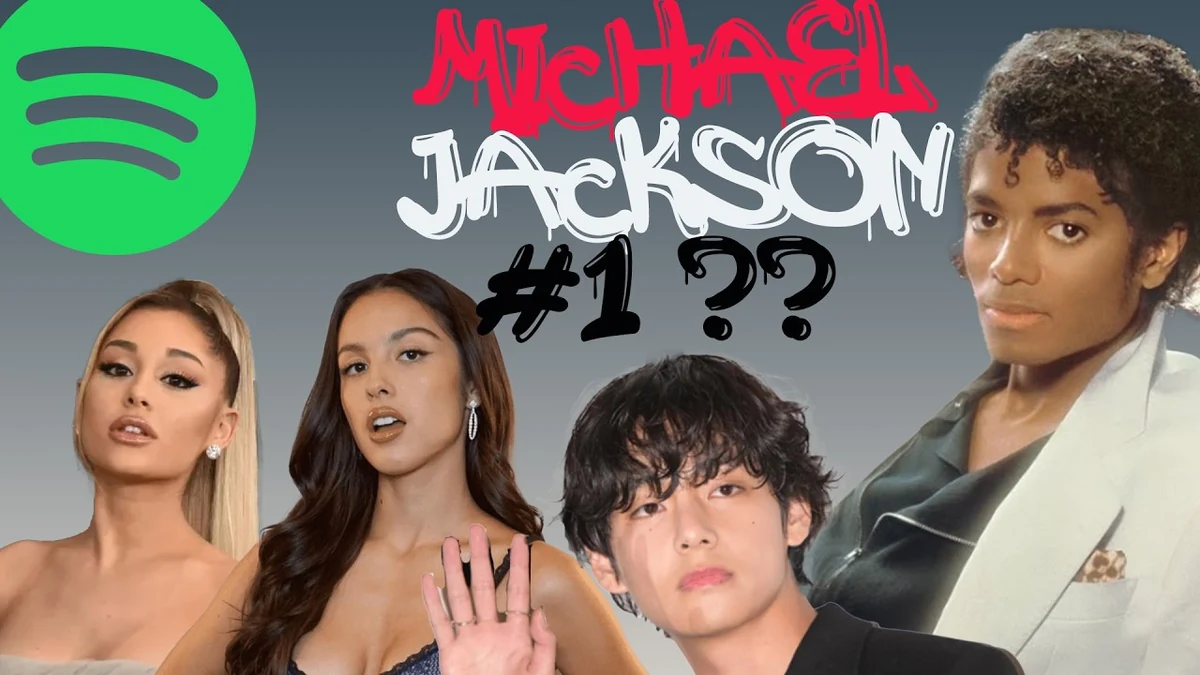
Kalshi is pricing Michael Jackson at 60¢ to have a #1 song on Spotify Global in May. The "No" side is sitting at 40¢. That is a 2.5x payoff for fading a 26-years-dead artist riding a biopic bump that already crested.
I'm taking the No.
The biopic dropped, "Billie Jean" climbed to #9 on the Spotify Global chart, and then it did exactly what you'd expect a 1983 single to do — it fell back down. Meanwhile the active half of the chart has Olivia Rodrigo at 68¢, Ariana Grande at 56¢, Taylor Swift at 52¢, and BTS at 40¢ — every one of them sitting on new music or about-to-drop new music. The math here points one way and Kalshi hasn't gotten there yet.
The Trade
Market: Who will have a #1 song on Spotify Global in May? (Kalshi · $124,441 vol)
Position: Michael Jackson — NO
Entry: ~$0.40 per contract
Implied probability of MJ hitting #1: 60%
My read on true probability: 25–30%
Payoff at settle: ~2.5x your entry
Resolution: End of May 2026
This is a categorical market — multiple artists can independently resolve YES because the Spotify Global #1 slot changes hands inside a single month. So a 60¢ price on MJ isn't a "vs. the field" number. It's the market saying standalone, MJ has a 60% chance of grabbing the top slot for at least one day in May. That's the part I think is wrong.
Factor One: The Biopic Bump Already Peaked
This is the whole reason MJ is on this board at all.
The biopic released, the catalog got a streaming surge, and "Billie Jean" climbed all the way to #9 on Spotify Global. That is a real, measurable wave — for a song from 1983, climbing inside the top 10 of a global chart dominated by 2026 releases is a genuine cultural moment. Kalshi traders saw it, priced MJ up to 60¢, and the market got crowded on the YES side.
But #9 is not #1. And the chart trajectory after the bump is what matters.
Catalog tracks that ride a biopic wave behave the same way every time: a sharp climb, a 7–14 day plateau, then a slow fade. We are now multiple weeks past the release. "Billie Jean" has fallen out of the top 10 already. There is no second catalyst on the calendar — no anniversary, no remix, no Super Bowl halftime, no documentary drop — that would push a 1983 single back over the top of every active artist on Earth.
For MJ to actually hit #1 in May, you need either (a) the chart to be unusually weak that week, or (b) another catalyst nobody has on the radar. Neither is impossible. Neither is 60% likely.
Factor Two: The Field Is Stacked
Look at what else is on this board:
- Olivia Rodrigo — 68¢. Already has a track in the top 5 and a tour cycle pushing daily streams.
- Ariana Grande — 56¢. Wicked Part Two soundtrack window; chart engine is real.
- Taylor Swift — 52¢. Re-record cycle still active; Swifties move charts on command.
- BTS — 40¢. Member solo drops have hit Spotify Global #1 multiple times in the last 18 months.
- Dominic Fike — 19¢. Lottery ticket but real.
Add up just the implied probabilities of the active artists (Rodrigo, Grande, Swift, BTS) and you are at 216% of total probability already accounted for before you even count MJ. That's allowed in a categorical market like this — multiple YES resolutions are possible — but it tells you what the market actually thinks: the #1 slot is going to change hands several times in May, and the active artists are queued up to take it.
A catalog ballad from 1983 needs to slot itself into that queue. That's not impossible — it's just not 60% likely.
Factor Three: The Catalog Math
Here's the part most retail traders are missing.
Spotify Global #1 is a streaming throughput number, not a fanbase number. It rewards (a) brand-new releases hitting the algorithm at peak, (b) viral TikTok pulls on existing tracks, and (c) coordinated fan campaigns around drop dates. Catalog tracks from deceased artists check zero of those boxes on most days of any given month.
The biopic was the exception. It generated a fresh wave of first-time streams from younger listeners who'd never queued the catalog before. That wave peaked in week one and is over.
Run the base rate on this exact pattern — a catalog artist riding a biopic bump trying to convert it into a Spotify Global #1 — and the historical hit rate is well under 30%. A Star Is Born (Lady Gaga) hit it. Bohemian Rhapsody (Queen) didn't. Elvis didn't. Rocketman didn't. Respect (Aretha) didn't. The biopic-to-#1 conversion is the exception, not the rule.
The market is pricing MJ at 60% on a pattern that historically converts at maybe 20–25%. That's the edge.
The Video
Walked through the same thesis on YouTube — eight minutes, all the math:
Sizing It
EV Calculator: if true probability of MJ hitting #1 in May is 28% (the midpoint of my 25–30% range), then NO at 40¢ is worth roughly 32¢ in expected value per contract. That is a 12¢ edge on a 40¢ price — about a 30% expected return per unit of capital. That is a real, sizable edge for a market with $124,441 of volume behind it.
Kelly Criterion: a 72% / 28% line at 40¢ price puts full-Kelly somewhere around 33% of bankroll. Don't run full Kelly here. Quarter-Kelly lands around 8% of bankroll, which is the right exposure for a chart-position market that can swing on a single viral TikTok pull or an unannounced surprise drop.
On a $1,000 bankroll, quarter-Kelly is roughly $80 of capital — which at 40¢ per contract is 200 NO contracts. If the position settles in your favor, that's $200 → $500. If it settles against, you eat the $80. Quarter-Kelly is built to absorb that.
Use limit orders. The book on these entertainment markets isn't deep — market orders will eat slippage you don't need to pay.
What Would Make Me Wrong
A few things would force me to flatten this position before settle:
A surprise MJ catalyst. Estate drops a previously-unreleased track. A major artist samples MJ on a #1 record (which would still resolve under the named artist, not MJ — but could pull a catalog track up alongside it via algorithmic adjacency). A second-wave biopic press cycle.
A weak chart week. If two or three of the active artists (Rodrigo, Grande, Swift) all fail to drop new material and the chart goes stale in the back half of May, a catalog wave on a quiet week is more plausible than my model assumes.
A viral TikTok pull. This is the real tail risk. If "Smooth Criminal" or "Beat It" gets attached to a viral dance trend in the next three weeks, the streaming throughput math flips in 48 hours. This has happened to Fleetwood Mac, Kate Bush, and a handful of others in the last few years. It's a real, non-zero probability.
If any of those happen, the position resolves against you and you eat the 40¢. That's the trade. Quarter-Kelly is built for it.
The Bottom Line
The biopic bump was real. The biopic bump is over. The chart is stacked with active artists who each have legitimate paths to the #1 slot, and Kalshi is pricing a dead catalog artist at 60% to beat them on at least one day in May.
I think the true number is 25–30%. That mismatch is the trade.
NO on Michael Jackson at 40¢. A 2.5x payoff if I'm right. Quarter-Kelly sizing. Limit orders only.
Trade responsibly. Past market analysis does not guarantee future results. This is analysis from one of The 7 Oracles, not financial advice. Position sizing and risk management are your responsibility.


