I worked at CourtTV for half a decade. And I say that not as a flex — it still is one, I'll admit — but to give everyone some real insight into how trials actually work. Because they rarely do.
My job was technically "Associate Producer," but what I was really doing was scouring the country for interesting trials. Each week I'd put together a packet of four to six upcoming cases and present them to the executive producers. They'd dig in, ask questions, and decide what was worth covering. We'd apply for camera access, book hotels for hosts and field producers, coordinate with the other networks — and then the Friday before jury selection was about to start, the case would get delayed six months. Or it would plea out. Almost every single time.
The ones that didn't reach agreements were the high-profile ones — Anna Nicole Smith, O.J. Simpson — or some random heinous act where a defense attorney figured the jury was their better shot. Even then, by and large, cases resolved early. Sometimes the morning of jury selection.
But the ones that didn't? Big or small, they became compelling TV. Because when there's no deal to be made, both sides actually have a solid argument. The outcome is genuinely 50/50. Even when a verdict was reached, we almost never knew which way it would go.
Why This Trial Matters Here
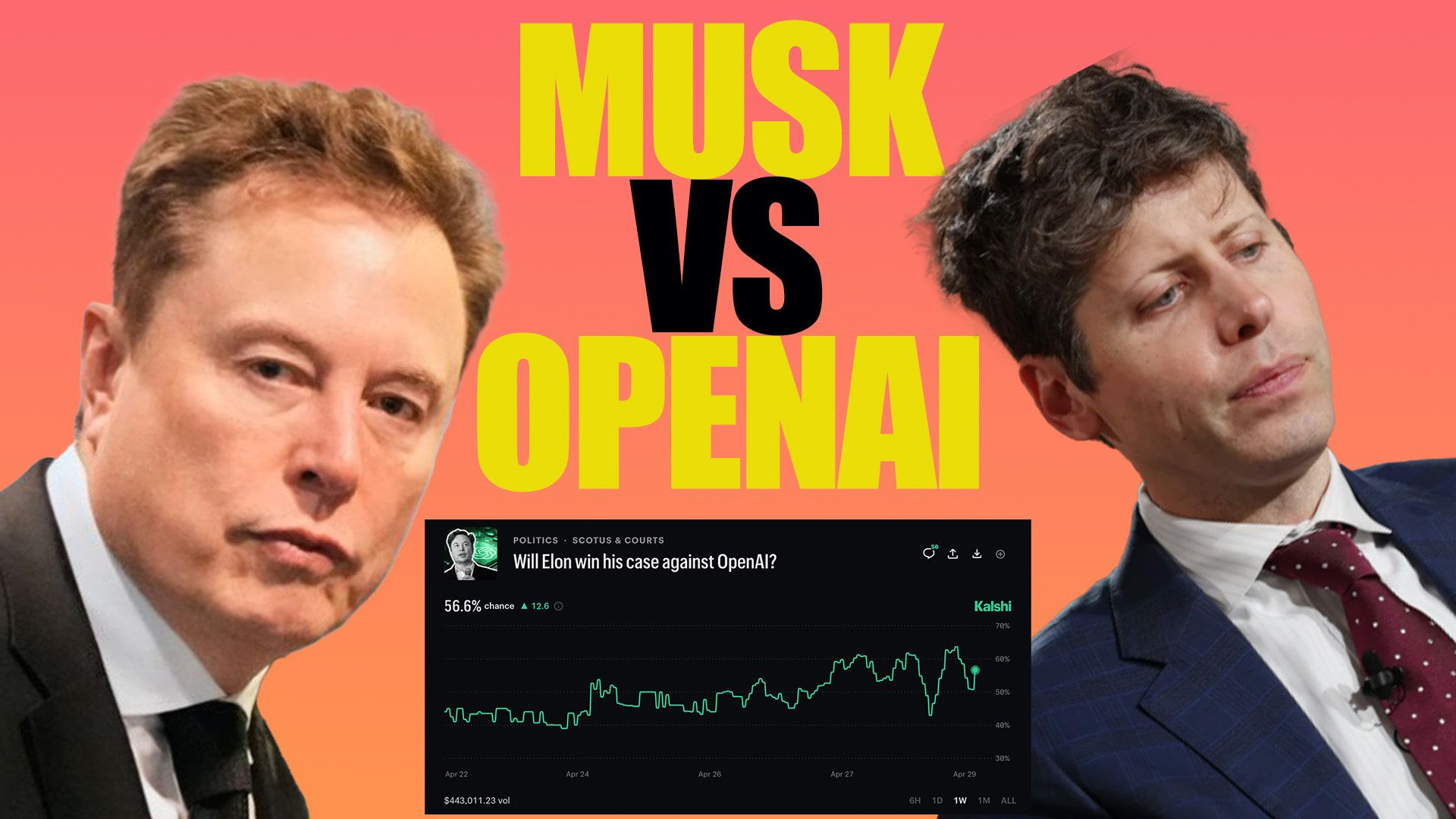
I bring all that up because Elon Musk has gone to trial against OpenAI and Sam Altman. Of the original 26 claims, he eventually narrowed it to two, and he's seeking $180 billion — money he wants directed to OpenAI's non-profit arm. The New York Times has been running a live blog.
This matters to us for two reasons. First, the outcome could influence the future of AI and, frankly, humanity. Second, Kalshi lets you take a position on it.
It is a legitimately fantastic case. Star power. An unpredictable Musk on his third day of testimony Thursday. Regrettably-sent emails. Legitimate geniuses. The still-evolving world of AI. A jury the judge tried to filter of news junkies. It should be a genuine coin flip in either direction — despite the Wall Street Journal framing Musk as an underdog before the trial kicked off.
What the Market Is Telling Us
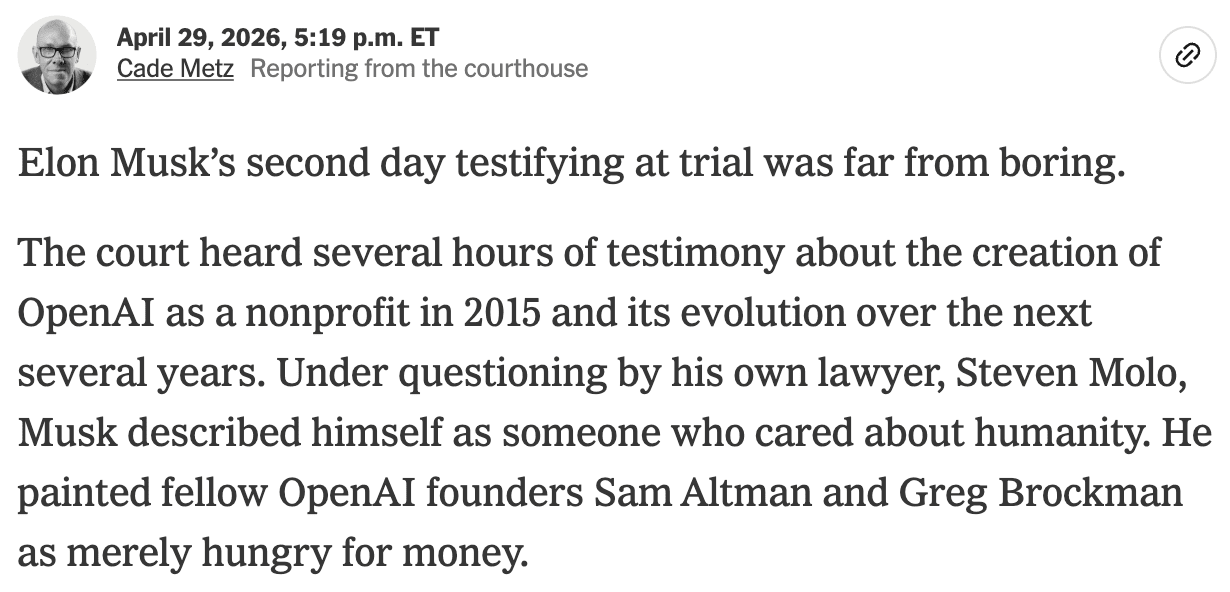
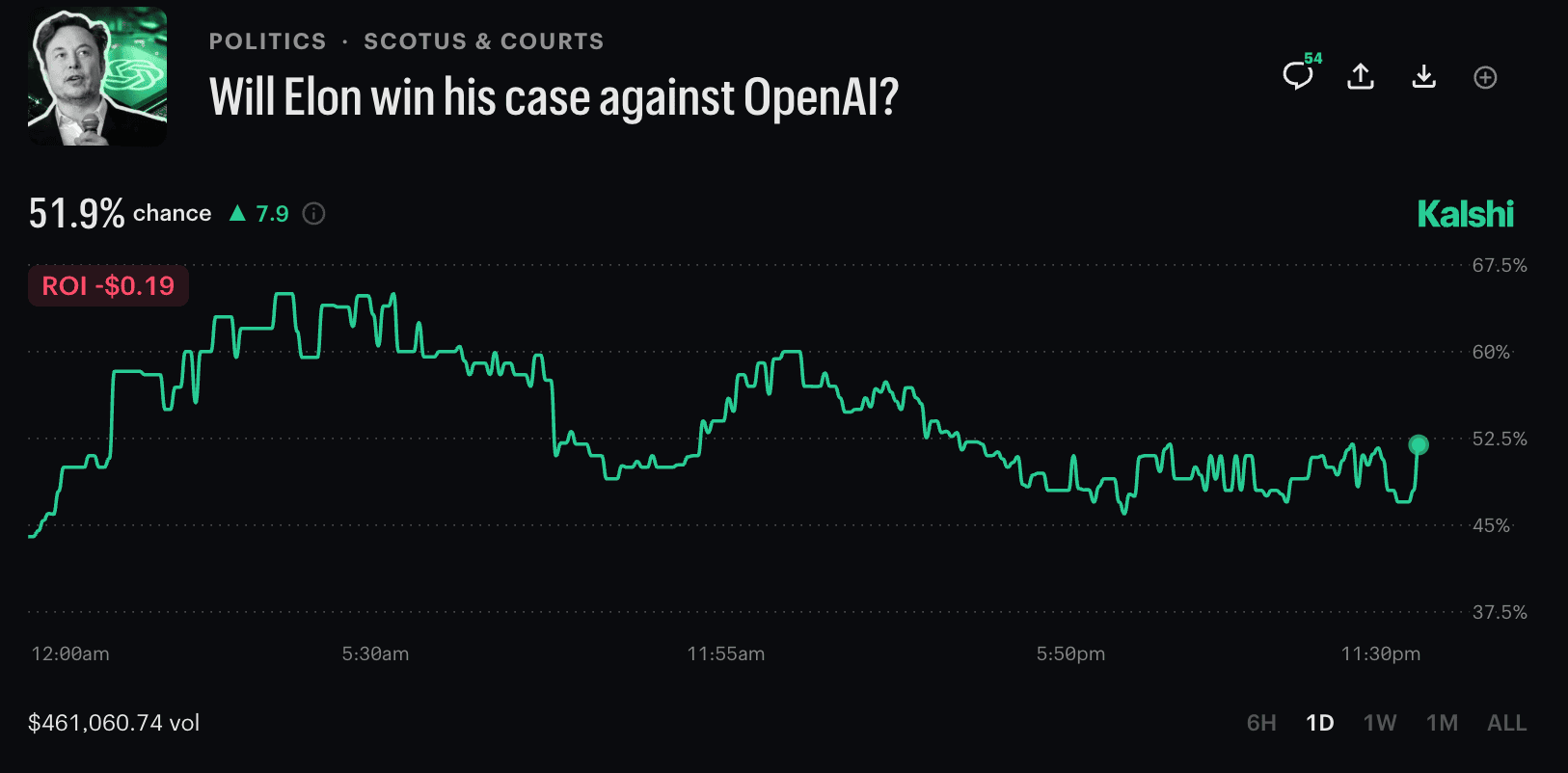
This market has delivered. The price chart is already a roller coaster.
At 4:17 a.m. ET Wednesday, YES shot up to 67% — something clearly moved overnight. By 5:45 p.m., it had cratered to 48%. Musk's second day on the stand featured a relatively positive morning and then combative cross-examination from OpenAI's attorneys in the afternoon. His somewhat flummoxed responses pushed the number down. By midnight, it had clawed back to 50–52%.
That's when I jumped in. We're officially on YES.
The Case for YES
People are genuinely scared about what AI can become in the wrong hands. Elon Musk, whether you believe him or not, has positioned himself as the last line of defense against all the evils that could come from it — driven by greed and bad actors.
So here's my hunch: despite jurors trying their best to stay impartial, some of them are going to see Musk as someone genuinely trying to do what's best for humanity. That theme runs through the entire trial. It's not abstract:
> "Under questioning by his own lawyer, Musk described himself as someone who cared about humanity. He painted fellow OpenAI founders Sam Altman and Greg Brockman as merely hungry for money."
If the jury gets sympathetic — even subconsciously — to Musk's "savior of humanity" framing? He wins. If a couple of jurors dig in and refuse to budge? We get a hung jury, and per the market rules, that means no superior outcome for either party — our money comes back.
That's the other reason I like this position: saying YES to "Elon wins" does not lose on a hung jury or a mistrial. Those two outcomes are very much in play here. According to Kalshi's resolution criteria, there has to be a "superior outcome" — a clear winner — for YES or NO to resolve. And my gut says if it isn't a hung jury, it'll be a Musk victory.
My personal power rankings on outcomes: 1. hung jury, 2. mistrial, 3. Musk win, 4. OpenAI win. OpenAI winning outright is the least likely scenario on this board.
The Sell Option
And here's the beauty of it. If something breaks public sentiment in a big way — an analysis from CNN or Fox News that "Musk is definitely winning after today," a viral tweet from a major legal or political account calling it done — and YES jumps to 75 or 80¢? We can sell. That's what these markets are built for.
The Play
Kalshi no longer lists a contract on this case — see the current markets on Kalshi →
Enter YES as close to 50% as you can get. Let the media paint him as the good guy here. Despite OpenAI's attorneys strategically reminding jurors that Musk is a Trump ally, the "standing between us and out-of-control AI" framing is a far more powerful factor for any juror weighing the decision. This is a game of biases. Public sentiment is on his side.
Use the Kelly Criterion tool to size your position responsibly — the resolution window here is wider than a typical market, and there's tail risk (vetting story, Musk withdraws, Trump-style left-field pivot). Quarter-Kelly is the right exposure.
The Bottom Line
I spent five years watching cases that looked like sure things settle at the last second. This one didn't. Both sides have a real argument. The market is at 50-52¢ and has $461,000 behind it.
The jury is going to decide this. And I believe a jury in 2026 is more likely to side with the guy who says he's trying to save the world from AI than the company that turned itself for-profit after taking his funding.
YES on Elon. Trade responsibly.
This is market analysis, not legal or financial advice. Position sizing and risk management are your responsibility. Past analysis does not guarantee future results.
Choosing your platform before you take this trade: Kalshi vs DraftKings, FanDuel vs Kalshi, and Kalshi vs Polymarket are the three comparisons most readers ask about. DraftKings vs Polymarket covers the alternative pair. Sizing it as a multi-leg? Use the Kalshi parlay calculator.